
The Ultimate Guide to Medical Exam Lights: Enhancing Patient Care & Clinical Accuracy
Imagine a seasoned physician leaning in for a closer look. The patient presents with a subtle rash, a hint of jaundice, or a wound whose true color holds the key to diagnosing infection. Now, imagine that critical visual assessment is happening under the harsh, green-tinged glow of an old fluorescent fixture or the dim, shadowy light from a poorly positioned lamp. What if a missed diagnosis or a delayed treatment plan was due not to a lack of clinical skill, but to poor lighting?
This scenario is not mere speculation. Inadequate or improper illumination in clinical settings is a silent, pervasive challenge. It leads to significant problems: accelerated eye strain and musculoskeletal fatigue for practitioners, increased anxiety and discomfort for patients, and, most critically, the potential for diagnostic oversights. In the high-stakes world of healthcare, where visual cues are paramount, the quality of light is inseparable from the quality of care.
The engineered solution to this problem is the medical exam light. Far more than a simple room fixture, it is a precision diagnostic tool, an ergonomic aid, and a component of patient-centered design. This guide serves as a comprehensive, evidence-based resource for healthcare professionals, clinical facility managers, and procurement specialists. Our purpose is to move beyond basic specifications and explore how the right lighting technology directly impacts clinical outcomes, practitioner well-being, and operational efficiency. By the end, you will have a clear understanding of the key features, types, and selection criteria for medical exam lights, empowering you to make informed, strategic decisions for your practice.
Why Medical Exam Lighting is a Critical Clinical Tool
Medical lighting transcends the basic function of “brightening a room.” It is a fundamental component of the diagnostic and therapeutic process, engineered to meet the exacting demands of clinical observation.
Beyond Illumination: Impact on Diagnostic Accuracy
The human eye is a remarkable instrument, but its performance is entirely dependent on the quality of light available. For accurate clinical assessment, light must reveal the true color and detail of tissue. This is where technical metrics become clinically significant.
- Assessing Tissue Color: Is that skin pallor indicative of anemia? Is the sclera truly icteric (jaundiced)? Is a wound bed showing healthy granulation (red) or signs of necrosis (yellow/black)? Accurate color discrimination is vital. Medical-grade lights with a high Color Rendering Index (CRI)—often 90 or above—ensure that colors are rendered as they would appear under ideal, natural light. A low CRI can distort these subtle hues, leading to misinterpretation. Clinical guidelines for wound care and dermatological assessment explicitly emphasize the need for consistent, high-quality illumination to evaluate healing progress and lesion characteristics accurately.
- Detecting Subtle Details: A faint rash, the fine capillaries in a newborn’s skin, or the texture of a mucosal membrane—all require illumination that minimizes glare and enhances contrast. Proper medical lighting is designed to provide even, diffuse light that reveals detail without washing it out or creating confusing shadows.
Reducing Practitioner Fatigue and Improving Ergonomics
A typical healthcare provider spends hours each day performing visual tasks. Poor lighting forces the eyes to constantly refocus and strain to discern details, leading to headaches, dry eyes, and fatigue. This visual strain, known as asthenopia, can reduce concentration and increase error rates.
Furthermore, exam lights that are difficult to position or that create deep shadows force practitioners into awkward, sustained postures—craning the neck, hunching the back, or holding uncomfortable positions to “find the light.” Modern, fully articulating exam lights are designed for ergonomic efficiency. They allow the light to be positioned precisely where needed with minimal effort, keeping the practitioner’s posture neutral and their focus on the patient, not on wrestling with equipment. This aligns with broader occupational health initiatives to prevent work-related musculoskeletal disorders in healthcare.
Enhancing Patient Comfort and Experience
The clinical environment can be intimidating. A bright, hot light shining directly into a patient’s eyes as they lie on an exam table adds unnecessary stress. Patient-centered medical lighting addresses this directly.
- Dimmability: The ability to lower the light intensity during less invasive parts of an exam or for light-sensitive patients reduces glare and anxiety.
- Cool Operation: Modern LED exam lights emit minimal radiant heat compared to old halogen bulbs. This “cool-to-the-touch” quality is essential for patient comfort, especially during procedures where the light source must be close to the skin.
- Directional Control: Lights that can be focused precisely on the area of interest prevent unnecessary illumination of the patient’s face, creating a more respectful and comfortable experience.
Key Features & Technologies in Modern Medical Exam Lights
Understanding the technical language of medical lighting is key to selecting the right tool. Here are the core features that define performance.
Understanding Light Quality Metrics: CRI, CCT, and Lux
- CRI (Color Rendering Index): Measured on a scale of 0-100, CRI indicates how accurately a light source reveals the true colors of objects compared to a natural reference light (like daylight). For clinical settings where color judgment is critical, a CRI of 90 or higher is considered the medical standard. A light with a CRI of 95+ provides exceptional color fidelity.
- CCT (Correlated Color Temperature): Measured in Kelvin (K), CCT describes the apparent “warmth” or “coolness” of white light.
- Warm White (2700K-3500K): Has a yellowish hue. It is often used in waiting areas or patient rooms for a calming ambiance but is less common for task lighting in exams.
- Cool White (4000K-5000K): Has a neutral to slightly bluish white. This range is most prevalent in medical exam lighting as it promotes alertness and provides excellent contrast for detail-oriented tasks.
- Day White (5000K-6500K): Very cool, bluish-white, mimicking midday sun. Often used in surgical suites for maximum contrast in deep cavities.
- Lux (Illuminance): This measures the amount of light (luminous flux) falling on a surface (illuminance). Recommendations vary by task:
- General Examination: 1,000 – 2,000 lux at the examination point.
- Minor Procedures/Suturing: 5,000 – 10,000 lux or more.
- Major Surgery: 20,000 – 100,000+ lux at the center of the surgical field.
LED Technology: Efficiency, Longevity, and Cooler Operation
The shift from halogen and incandescent bulbs to Light Emitting Diode (LED) technology has revolutionized medical lighting.
- Efficiency & Cost: LEDs consume up to 80% less energy than halogen bulbs for the same light output, leading to substantial long-term savings on electricity.
- Longevity: A typical halogen bulb lasts 1,000-2,000 hours. An LED module can last 50,000 to 100,000 hours, effectively eliminating the cost and hassle of frequent bulb replacements over the life of the fixture.
- Cooler Operation: LEDs convert most energy into light, not heat. This eliminates the burn risk to patients and staff and reduces thermal discomfort during long procedures.
Design for Function: Adjustability, Sterilization, and Durability
The best light is useless if it can’t be positioned correctly or kept clean.
- Adjustability: Look for lights with multiple points of articulation (spring-balanced arms, rotating heads) that offer a wide range of motion and can be positioned smoothly and locked securely. The reach should be sufficient to cover the entire exam table or procedure area.
- Sterilization & Infection Control: In today’s healthcare environment, every surface is a potential fomite. Medical exam lights should have seamless, non-porous housings that can withstand frequent wiping with hospital-grade disinfectants. Some feature antimicrobial coatings on high-touch handles. The design should have minimal seams and crevices where pathogens can hide.
- Durability: These are workhorse instruments. They must withstand daily manipulation, occasional impact, and years of cleaning. High-quality materials (medical-grade polymers, anodized aluminum) and robust construction in the joints and arms are essential.
Types of Medical Exam Lights and Their Applications
The “right” light depends entirely on the clinical task. Here’s a breakdown of the main categories.
Overhead Examination Lights (Ceiling-Mounted)
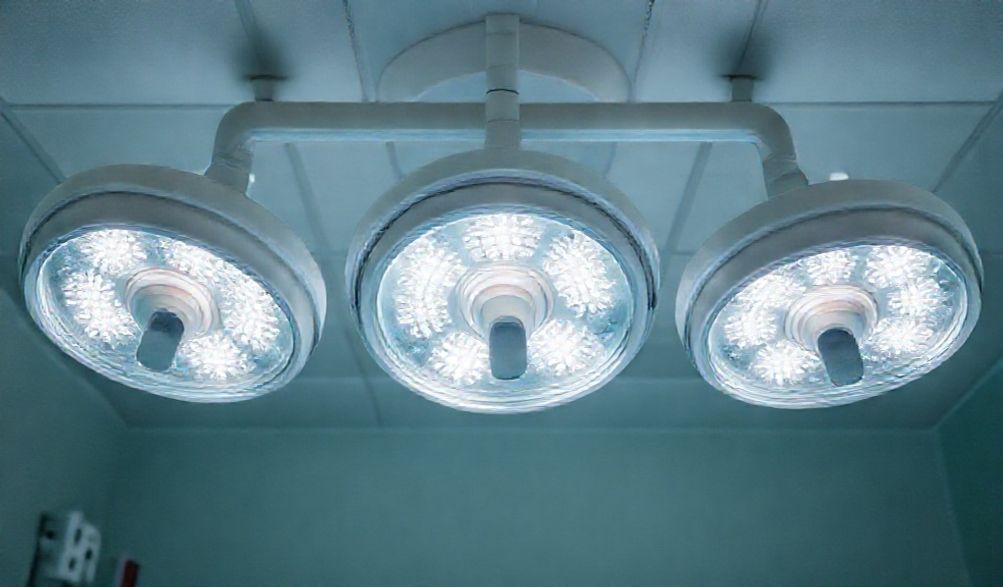
These are the workhorses of general exam rooms, urgent care centers, and outpatient clinics.
* Pros: Hands-free operation, out of the way, provides broad, even illumination over a standard exam table.
* Cons: Limited ability to illuminate specific, hard-to-reach angles compared to more articulated lights.
* Ideal For: Routine physical exams, pediatric check-ups, and general assessment.
Procedural & Surgical Lights
These are highly specialized instruments designed for invasive procedures where deep-cavity illumination and shadow control are critical.
* Key Features: Extremely high intensity (lux), sophisticated optical systems that minimize shadows even when hands or instruments intrude (shadow dilution), and often a central “cold” light source transmitted via fiber optic cables. They must meet stringent international safety standards for medical electrical equipment, such as IEC 60601-2-41.
* Ideal For: Minor surgery (laceration repair, biopsies), procedure rooms, and of course, operating theaters.
Portable Diagnostic Lights (Wall-Mounted & Handheld)
These offer flexibility for focused examinations.
* Wall-Mounted Swing Arms: Provide excellent, adjustable task lighting that can be swung into position as needed, then pushed out of the way. Perfect for multi-use rooms.
* Handheld Penlights & Otoscopes: For pupil checks, focused oral/ENT exams, and assessing skin lesions. They offer ultimate portability.
* Ideal For: Focused exams, wound checks on rounds, and supplementing overhead light in specific areas.
Specialized Lights: Transilluminators, Otoscopes, & Slit Lamps
These are dedicated tools for specific diagnostic purposes.
* Transilluminators: Use bright, cool light to illuminate body cavities (e.g., checking sinus cavities in infants, locating veins).
* Slit Lamps: Provide a high-intensity, adjustable slit of light for detailed examination of the eye’s anterior segment.
* Otoscopes: Combine light and magnification for examining the ear canal and tympanic membrane.
How to Choose the Right Medical Exam Light: A Buyer’s Checklist
Selecting a medical exam light is an investment in clinical quality. Use this framework to guide your decision.
Assess Your Clinical Needs and Workflow
Start by asking fundamental questions:
* What specific procedures are most commonly performed in this room? (e.g., general physicals vs. wound debridement)
* How many practitioners use the space, and what are their height/positioning preferences?
* What is the room layout? Consider ceiling height, exam table placement, and the location of other equipment.
* Is this for a new build, a renovation, or a direct replacement?
Evaluate Technical Specifications Against Standards
Create a simple comparison table when reviewing models:
| Feature | Why It Matters | Minimum Recommendation for General Exam |
| :— | :— | :— |
| CRI | Accuracy of color assessment | ≥ 90 |
| CCT | Tone of white light; affects contrast | 4000K – 5000K |
| Lux @ Target | Sufficient brightness for the task | 1,500 – 2,000 lux |
| Adjustability | Reduces shadows & practitioner strain | Multi-joint arm, 360° rotation |
| Light Field Diameter | Size of the illuminated area | Adjustable, suitable for exam area |
Consider Total Cost of Ownership (TCO)
Look beyond the initial purchase price:
* Energy Consumption: LED lights will save significantly on electricity bills.
* Maintenance & Parts: What is the lifespan of the LED module? What is the cost and frequency of replacing fuses or mechanical parts? A longer warranty is often indicative of better build quality.
* Serviceability: Is local technical support available? Can components be easily replaced?
Safety and Regulatory Compliance
This is non-negotiable. Ensure any medical exam light you consider carries the appropriate safety certifications for your region (e.g., UL Listing in North America, CE Marking in Europe). Compliance indicates the product has been tested for electrical safety, mechanical safety, and electromagnetic compatibility, ensuring it is safe for use in a patient care environment.
Installation, Maintenance, and Safety Best Practices
Proper setup and care ensure your investment performs safely and reliably for years.
Professional Installation for Optimal Performance and Safety
Medical exam lights, especially heavy ceiling-mounted models, must be installed by qualified technicians.
* They will verify the ceiling structure can support the weight and torque of the light, especially when extended.
* They ensure electrical connections are safe and compliant with local codes.
* Proper installation ensures smooth operation and prevents dangerous failures.
Routine Cleaning and Disinfection Protocol
Always follow the manufacturer’s Instructions for Use (IFU). General principles include:
* Use a soft, lint-free cloth dampened with a hospital-grade, intermediate-level disinfectant.
* Gently wipe down all external surfaces, especially high-touch handles and control switches.
* Avoid spraying disinfectant directly onto the light. Spray the cloth first to prevent liquid from seeping into seams, joints, or electrical components, which can cause damage or failure.
Preventative Maintenance and Troubleshooting
- Regular Inspection: Periodically check for smooth articulation, consistent light output (no flickering or dimming), and that all knobs, locks, and fittings are secure.
- Basic Troubleshooting: If a light fails, a first step is to check if it is plugged in securely or if a circuit breaker has tripped. For lights with replaceable fuses, consult the manual.
- Critical Rule: For any internal electrical issue, mechanical repair, or if the light head is damaged, contact the manufacturer or a certified service provider immediately. Do not attempt internal repairs.
Frequently Asked Questions (FAQ) About Medical Exam Lights
Q1: What is the most important feature to look for in a general exam room light?
A: A combination of high CRI (>90) and excellent adjustability. You need accurate color rendering for diagnosis and the ability to position the light to eliminate shadows from any angle, which reduces eye strain.
Q2: How often do medical exam lights need to be replaced or serviced?
A: The LED modules themselves can last 50,000+ hours (over a decade of typical use). Servicing is typically driven by mechanical wear on the joints and arms. An annual inspection of movement, stability, and light output is a good practice.
Q3: Can standard LED lights from a hardware store be used for medical examinations?
A: No. Consumer-grade LEDs often have poor, inconsistent CRI and unregulated color temperature, which can distort clinical findings. Medical-grade lights are designed and tested to meet specific, high standards for color accuracy and safety.
Q4: Are there specific lights for teledermatology or telehealth?
A: Yes. Consistent, high-CRI lighting is critical for accurate digital image capture. Some lights are specifically designed for telehealth setups, offering standardized color temperature and brightness to ensure the images a remote specialist sees are true-to-life.
Q5: How do I safely clean a medical exam light?
A: Always defer to the manufacturer’s IFU. Generally, power off the light, use a soft cloth with an approved hospital-grade disinfectant, and wipe down non-porous surfaces. Avoid abrasive cleaners and never spray liquid directly onto the fixture, especially near joints or vents.
Conclusion
Medical exam lights are far from a generic commodity or an afterthought in room design. They are a vital diagnostic instrument that directly influences patient outcomes, safeguards practitioner well-being, and enhances clinical efficiency. The choice between adequate lighting and optimal lighting can be the difference between guesswork and confidence in a diagnosis.
When specifying or purchasing medical exam lights, prioritize quality, compliance, and ergonomics over upfront cost alone. Investing in the right technology pays long-term dividends in diagnostic accuracy, staff satisfaction, and reduced operational costs. This guide was created to empower healthcare decision-makers with trustworthy, expert-backed information, transforming the selection of medical lighting from a procurement task into a strategic initiative for enhancing the entire practice environment.
Ready to illuminate your clinical practice? Consult with a reputable medical equipment supplier who understands clinical workflow, request a demonstration of different models in your actual space, and download detailed specification sheets to compare the features that matter most for your patients and your team.
p>