
How Do Surgical Lights Not Cast Shadows? The Science of Shadowless Illumination
Picture a cardiac surgeon poised to perform a delicate coronary artery bypass. Their hands are steady, their focus absolute. The target vessel is mere millimeters wide. Now, imagine a dark, shifting shadow falling across the incision site at the critical moment, obscuring the subtle color difference between the artery and the surrounding tissue. The risk is immediate and profound: a misplaced stitch, prolonged operative time, or worse. This scenario underscores why shadow elimination in the operating room is not a mere convenience—it is a non-negotiable pillar of patient safety and surgical precision.
The seemingly simple question, “How do surgical lights not cast shadows?” opens a window into a world of sophisticated engineering, applied physics, and stringent medical standards. The answer lies not in magic, but in deliberate, multi-faceted design that has evolved over decades. This guide will serve as your definitive resource on the principles and technologies behind shadowless surgical illumination, explaining the core concepts that make modern surgery possible. The following insights are grounded in the principles of optics and medical device engineering, presented with clarity and accuracy to demystify this critical operating room technology.
The Critical Role of Lighting in Modern Surgery
surgical lighting does far more than just “light up the room.” It is a fundamental tool that directly influences the surgeon’s performance, the procedure’s efficiency, and ultimately, the patient’s outcome.
Beyond Illumination: How Lighting Affects Surgical Outcomes
Think of a surgeon’s vision as their primary interface with the surgical field. Optimal lighting enhances three key visual factors:
- Visual Acuity: The ability to see fine detail. High-intensity, focused light allows surgeons to distinguish minute structures like nerve fibers or small capillaries.
- Color Rendition: The accuracy with which a light source reveals the true colors of tissues. Accurate differentiation between arterial blood (bright red), venous blood (darker red), fatty tissue (yellow), and muscle is vital.
- Depth Perception: The ability to perceive the world in three dimensions. Properly directed light creates subtle contrasts and highlights, helping the surgeon judge depths within a cavity, which is crucial for procedures like deep abdominal or spinal surgery.
Poor lighting forces the surgeon’s eyes to work harder, leading to visual fatigue, eye strain, and decreased concentration over long procedures. This cognitive load can increase the potential for human error.
The Problem of Shadows: More Than Just an Annoyance
In the context of surgery, a shadow is more than an absence of light; it is a source of risk.
- Obscured Anatomy: A shadow can hide a critical structure, a bleeding point, or a pathological finding.
- Misinterpretation: Shadows can alter the perceived shape, depth, or color of tissue, leading to misjudgment.
- Increased Procedure Time: Surgeons and assistants may need to constantly reposition lights or themselves to chase away shadows, disrupting workflow and prolonging anesthesia time.
Clinical guidelines and ergonomic studies consistently emphasize that optimal visualization is a prerequisite for safe surgery. The elimination of shadows is, therefore, a primary design goal, not an afterthought.
Core Principles: How Shadow Reduction is Achieved
The secret to shadowless lighting isn’t a single trick, but the intelligent application of a few core principles of physics and design.
The Multi-Source Solution: Why Multiple Lamps are Key
The fundamental reason a single light creates a sharp shadow is that it acts as a point source. When an object (like a surgeon’s head or hands) blocks this single point, all light behind it is obstructed, creating a dark shadow with a sharp umbra (full shadow) and softer penumbra (partial shadow).
The solution is to use multiple light sources from different angles. If one source is blocked, light from the other sources fills in the shadowed area from a different direction. Think of the difference between a sunny day (sharp shadows from the single sun) and a cloudy day (soft, diffuse light with no shadows because the clouds act as a massive, multi-directional light source). Surgical lights mimic this “cloudy day” effect on a controlled, intense scale.
Understanding the “Halogen Circle” and Optical Design
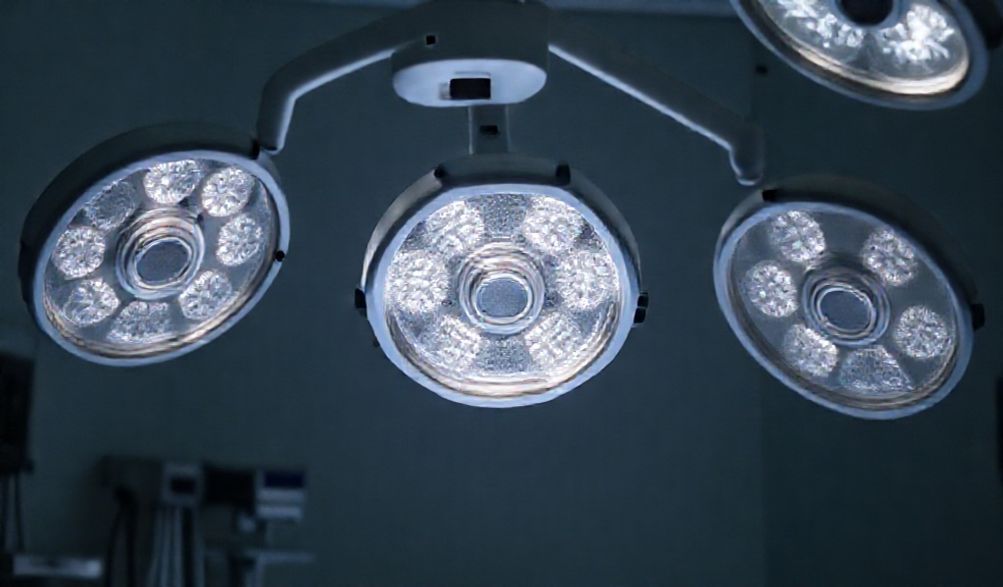
Traditional surgical lights, often called “halogen circles,” perfectly illustrate this principle. A single lighting head contains a circular array of individual halogen bulbs—often 30, 60, or more—arranged in concentric rings around a central point.
Each bulb projects its beam of light onto the same surgical field, but from a slightly different angle. The shadows cast by an obstruction from one bulb are immediately illuminated by the beams from the surrounding bulbs. The result is not a single shadow, but dozens of faint, overlapping shadows that are so diluted they become imperceptible to the human eye. This overlapping creates a homogenized, “shadowless” pool of light.
The Role of Reflectors and Lenses in Beam Control
Simply having multiple bulbs isn’t enough. The light must be powerful, focused, and deep-penetrating. This is where precision optics come in.
Behind each bulb is a parabolic reflector. This mirror-like surface collects the omnidirectional light emitted by the bulb and reflects it into a strong, parallel beam. This process is called collimation.
This parallel beam then passes through a large, Fresnel lens on the front of the light head. A Fresnel lens is a flat, thin lens with a series of concentric grooves that act like the curves of a traditional thick lens. It further focuses and directs the collimated light, ensuring it reaches the surgical site with high intensity and minimal scatter. This design allows the light to penetrate deep into body cavities (like during open abdominal surgery) without losing its power or creating glare at the surface.
Deep Dive: Technologies in Modern Surgical Lights
While the multi-source principle remains constant, the technology within surgical lights has undergone a revolutionary shift.
LED Revolution: Efficiency, Coolness, and Longevity
Modern surgical lights have overwhelmingly adopted Light Emitting Diode (LED) technology, replacing older halogen and xenon bulbs.
- Efficiency & Longevity: LEDs consume significantly less energy and have lifespans of 20,000 to 50,000 hours, compared to 1,000-2,000 hours for halogens, drastically reducing maintenance and replacement costs.
- Coolness: Perhaps most critically, LEDs emit very little infrared (heat) radiation. Traditional lights could generate substantial heat, potentially drying out exposed tissues or causing discomfort for the surgical team. LED lights are “cool” in terms of radiant heat.
- Consistent Color Temperature: LEDs provide a stable, daylight-mimicking color temperature (often around 4000K-4500K) that remains consistent throughout their long life, unlike halogens which yellow as they age.
Light Field Shape and Homogeneity
Advanced optical systems now create sophisticated light field patterns. Key metrics include:
- Depth of Illumination: The distance over which the light maintains a useful intensity (e.g., 40,000 lux at 1 meter, still 20,000 lux at 1.5 meters). This allows surgeons to work deep in a cavity without needing to constantly readjust the light.
- Homogeneity Index: A measure of how evenly the light is distributed across the field. A perfect score is 1.0. High-quality lights achieve >0.6, meaning there are no bright “hot spots” or dim edges, ensuring consistent visualization across the entire wound.
Color Rendering Index (CRI) and Tissue Differentiation
Color Rendering Index (CRI) is a scale from 0 to 100 that measures a light source’s ability to reveal the true colors of objects compared to a natural reference light (like daylight). In surgery, a high CRI is paramount.
- A CRI of >90 is considered excellent and is a standard requirement for surgical lights. A light with a low CRI might make arterial blood and venous blood look the same dull brown, a dangerous loss of critical visual information.
- Some advanced systems even offer adjustable CRI or specific color enhancement modes to improve contrast for certain tissues.
International standards, such as ISO 9680, specify minimum requirements for intensity, homogeneity, shadow dilution, and CRI for surgical luminaires, ensuring a baseline of performance and safety.
Types of Surgical Lighting Systems
Surgical lights come in various configurations to suit different procedural needs and operating room layouts.
Single vs. Dual Headlights: Flexibility and Coverage
- Single Headlights: Common for standard procedures in smaller ORs. They provide excellent shadow reduction from their multi-source design within a single head.
- Dual (or Multi-) Headlights: Feature two independent light heads mounted on a single boom. This offers superior flexibility. Two surgeons can position a head each for their optimal view, or both heads can be focused on a large field (e.g., in trauma or orthopedic surgery) from complementary angles, achieving near-total shadow elimination.
Ceiling-Mounted, Wall-Mounted, and Portable Options
- Ceiling-Mounted (on Booms): The most common and versatile. Booms offer a wide range of motion, keep the floor clear, and can be positioned precisely over the surgical field.
- Wall-Mounted: A space-saving solution for smaller rooms or specific setups, though with a more limited range of motion.
- Portable/Standing Lights: Used in minor procedure rooms, emergency settings, or as supplementary lighting. They offer mobility but generally have less sophisticated shadow control than major ceiling systems.
Considerations for Selecting Surgical Lights
Choosing the right surgical light involves evaluating a suite of performance and usability factors.
Key Performance Metrics to Evaluate
- Lux Intensity: Measured at a standard distance (e.g., 1m). 40,000-160,000 lux is a common range.
- Homogeneity: Look for a high index (>0.6).
- Shadow Dilution: The percentage reduction in shadow density. High-performance lights can achieve dilution of over 90%.
- Color Rendering Index (CRI): Must be >90.
- Heat Dissipation: Measured in watts per square centimeter at the illuminated site. Lower is better to prevent tissue desiccation.
Ergonomics and Sterility: The User Experience
The light must be easy and intuitive to use. Features include:
* Handle Design: Sterile, easy-grip handles that allow for repositioning without breaking the sterile field.
* Maneuverability: Smooth, balanced movement with minimal effort.
* Cleanability: The entire housing should be seamless and made of materials that can withstand harsh disinfectants to prevent infection.
Integration with the Operating Room Ecosystem
Modern ORs are integrated environments. Lights must be compatible with:
* Imaging Systems: Not interfering with endoscopic camera displays or causing glare.
* Equipment Booms: For mounting other devices like monitors or insufflators.
* OR Layout and Architecture: Considering ceiling height, table placement, and workflow.
FAQ Section
Q1: What is the “shadow dilution” percentage, and what is considered good?
A: Shadow dilution measures a light’s ability to reduce the contrast of a shadow created by an obstruction. It’s expressed as a percentage. For example, if a light has a 95% shadow dilution, it means the shadow is 95% less dark than it would be under a single point source. A dilution rate of 85% or higher is generally considered good for major surgical procedures, with high-end systems exceeding 95%.
Q2: Why is heat management so important in a surgical light?
A: Radiant heat from a light can dry out and damage exposed tissues (desiccation), potentially complicating healing. It also increases ambient temperature in the surgical field, causing discomfort for the heavily gowned surgical team and potentially increasing patient metabolic stress. LED technology’s minimal infrared emission directly addresses this critical issue.
Q3: Can surgical lights be adjusted for different types of surgery?
A: Yes. Many modern systems offer adjustable color temperature (e.g., warmer for surface tissue, cooler for deeper cavities) and focus (from a wide, shallow field for large incisions to a narrow, deep spot for cavity work). Some have programmable settings for specific specialties like neurosurgery or plastic surgery.
Q4: How long do modern LED surgical lights typically last?
A: The LED modules themselves can last 20,000 to 50,000 hours. To put that in perspective, if used for 10 hours a day, every day, that’s approximately 5.5 to 13.5 years before light output degrades significantly. This is a dramatic improvement over the 3-6 month lifespan of traditional halogen bulbs.
Q5: What’s the difference between “shadowless” and “low-shadow” lighting?
A: This is often a matter of terminology, but “shadowless” is the ideal goal achieved through the multi-source design. In practice, no light can eliminate all shadows if an object touches the surgical field itself. “Low-shadow” is sometimes used as a more technically precise term, indicating a light that reduces shadows to a clinically insignificant level (per ISO standards). High-quality surgical lights are effectively shadowless for all practical surgical purposes.
Conclusion
The question of how surgical lights avoid casting shadows reveals a remarkable synthesis of physics and engineering. The answer lies in the intelligent use of multiple light sources from a circular array, their beams meticulously collimated and focused by parabolic reflectors and Fresnel lenses, and their output refined by advanced LED technology for cool, consistent, and color-accurate light. This entire system is governed by strict international standards for intensity, homogeneity, and color rendering.
This technology is a silent, vital partner in the operating room. It does not make headlines, but it fundamentally enables the precision and safety of modern surgery. As we look forward, trends like adaptive lighting that automatically adjusts to the surgeon’s focus or integrates with augmented reality overlays for guided surgery are on the horizon. However, the core principle remains: in the high-stakes environment of surgery, relying on expertly engineered, clinically validated illumination is not an option—it is an absolute necessity for patient care.
p>