
Surgical Lamps: A Comprehensive Guide to Technology, Selection, and Safety
Introduction
What is the single most important tool in an operating room? While the surgeon’s skill is paramount, their ability to see—with absolute clarity, precision, and accuracy—is fundamentally enabled by one critical piece of technology: the surgical lamp. Imagine a complex vascular anastomosis or a delicate neurosurgical procedure performed under poor, shadow-filled, or discolored light. The risk of error increases, surgeon fatigue sets in faster, and patient outcomes can be compromised. Optimal illumination is not a luxury; it is a foundational pillar of modern surgical safety and success.
This comprehensive guide serves as an authoritative, expert-vetted resource for surgeons, OR nurses, hospital procurement teams, clinical engineers, and medical students. Our purpose is to demystify the sophisticated technology behind today’s surgical lighting, moving beyond catalog specifications to explain why these features matter in clinical practice. We synthesize insights from clinical studies, international safety standards, and manufacturer engineering to provide a holistic view.
Whether you are researching “surgical lamp” options for a new operating suite, seeking to understand the technical specifications impacting your daily work, or establishing maintenance protocols, this post will address your core concerns. We will explore the critical role of illumination, the evolution and inner workings of lighting systems, a practical checklist for selection, and essential safety and maintenance best practices. Let’s shed light on the device that illuminates the path to better surgical care.
The Critical Role of Illumination in Modern Surgery
Beyond Basic Visibility: How Lighting Affects Surgical Precision and Outcomes
A surgical lamp’s job extends far beyond simply “lighting up the room.” It is a precision tool designed to create an optimal visual environment within the surgical cavity. This directly influences several key factors:
- Depth Perception and Spatial Awareness: High-quality, homogeneous light eliminates flatness, allowing the surgeon to accurately judge the three-dimensional topography of tissues, vessels, and organs. This is crucial for suturing, dissection, and navigating anatomical planes.
- Tissue Differentiation: The ability to distinguish between subtly different tissue types—such as a nerve, a vessel, a tumor margin, or a fascia layer—can be the difference between a successful procedure and an inadvertent injury. Proper lighting enhances contrast and reveals these critical differences.
- Reduction of Visual Fatigue: Surgeons endure long hours of intense visual concentration. Lighting that causes glare, harsh shadows, or requires constant pupil adjustment leads to eye strain, headaches, and decreased concentration. Optimal lighting minimizes this cognitive load, helping the team maintain peak performance throughout a procedure.
Clinical studies underscore this link. Research has correlated improved illumination with reduced procedural times and lower rates of technical error. In essence, superior lighting is an ergonomic and cognitive aid that supports the surgical team’s skill, directly impacting efficiency and patient safety.
Key Lighting Parameters: Illuminance, Shadow Control, and Color Rendering
To evaluate a surgical lamp, you must understand the language of light measurement. Here are the core parameters:
- Illuminance (Lux): This measures the amount of light falling on a surface. In surgery, we discuss lux levels at a specific working distance (e.g., 100,000+ lux at 1 meter). However, more lux isn’t always better if it comes with excessive heat or poor distribution. Depth of Illumination is a related, critical concept—it’s the ability to maintain adequate light levels deep within a cavity, not just on the surface.
- Shadow Control: The term “shadow-free” is a misnomer; the goal is shadow dilution or compensation. This is achieved by using multiple light sources (like an array of LEDs) positioned at different angles within the lamp head. When a surgeon’s head or instrument obstructs one light path, the others fill in the shadow, drastically reducing its density and preserving a clear view.
- Color Rendering Index (CRI): Perhaps the most underappreciated yet vital specification. CRI measures a light source’s ability to reveal the true colors of objects compared to natural sunlight (which has a CRI of 100). A high CRI (>90, with >95 being ideal) is essential for accurately assessing tissue viability, oxygenation level of blood (bright red vs. dark burgundy), and identifying pathological changes. Low CRI lighting can make tissues appear washed out or misleadingly discolored.
Evolution and Technology of Surgical Lighting Systems
From Incandescent to LED: A History of Surgical Lighting
The journey to today’s advanced systems is a story of solving the twin problems of heat and control.
- Halogen and Metal Halide: These were the standards for decades, producing a bright, white light. However, they generated immense radiant heat, leading to tissue desiccation and increased OR temperatures. Their bulbs had short lifespans (1,000-2,000 hours) and required frequent, costly replacements.
- The LED Revolution: The adoption of Light Emitting Diode (LED) technology marked a paradigm shift. LEDs offer a dramatic reduction in infrared heat emission, exceptional energy efficiency (using up to 80% less power than halogen), and an extraordinarily long lifespan—often rated at 50,000 to 100,000 hours, which can translate to over a decade of normal use. This transition moved surgical lighting from a “consumable” to a long-term capital asset with a significantly lower total cost of ownership.
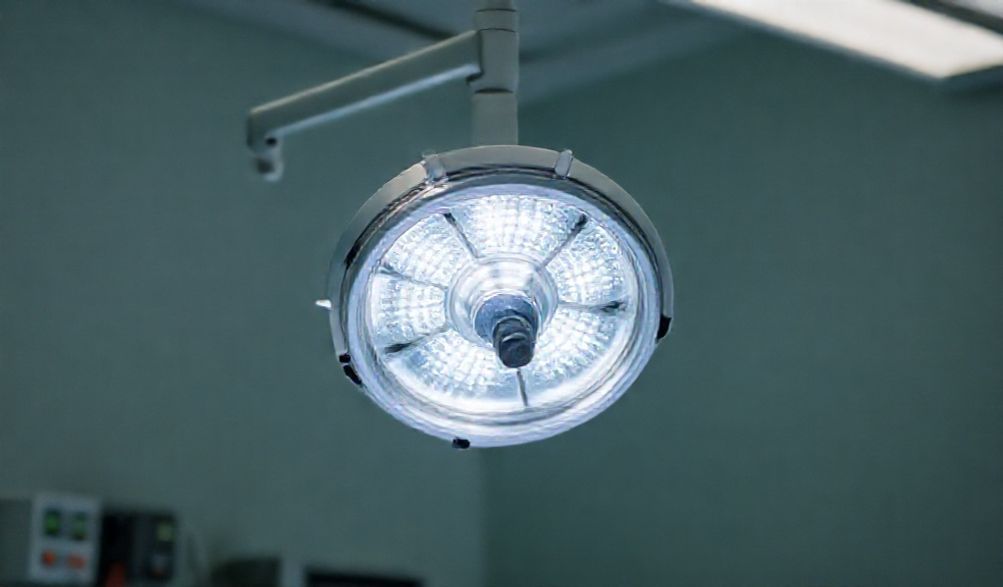
Inside a Modern LED Surgical Lamp: Core Components
A modern surgical light is a feat of optical and thermal engineering. Its core components work in concert:
- LED Arrays: Hundreds of individual LED chips are arranged in a specific pattern. This multi-source array is the foundation for shadow reduction and homogeneous light distribution.
- Heat Sinks: While LEDs run cool at the point of light emission, the electronic drivers generate heat. Massive, passive aluminum heat sinks draw this heat away from the LEDs, ensuring stable performance and longevity.
- Optical Lenses and Reflectors: Precision optics—lenses and specially shaped reflectors—collimate and direct the light from each LED, shaping the beam to achieve the desired field diameter, depth of illumination, and homogeneity.
- Control Electronics: This includes the drivers that provide constant current to the LEDs (preventing flicker) and the user interface for adjusting intensity, often via touch-sensitive handles or sterile touch panels.
Types of Surgical Lighting Systems
The right tool for the job varies by setting:
- Overhead Ceiling-Mounted Lamps: The workhorse of the main OR. Configurations include:
- Single/Standard: One lamp head on a boom.
- Dual/Two-Spot: Two independent lamp heads on a single boom, allowing two light fields that can be merged or used separately.
- Multi-Spot: Systems with three or more lamp heads for maximum flexibility in large-team surgeries like trauma or transplant.
- Surgical Headlights and Loupe Lights: Personal, fiber-optic or LED-based systems worn by the surgeon. They provide direct, coaxial illumination (light aligned with the surgeon’s line of sight), which is invaluable for deep-cavity or minimally invasive surgery where overhead light cannot reach.
- Specialty Lights: Includes lights for dental procedures, endoscopic light sources, and compact lights for minor procedure rooms or examination settings.
How to Choose the Right Surgical Lamp: A Procurement Checklist
Selecting a surgical lamp is a significant investment. This practical, experience-based checklist guides you beyond marketing claims to clinical and operational realities.
Clinical Requirements Assessment
Start with the needs of the people who will use it daily.
- Surgical Specialty: A high-intensity, large-diameter light with exceptional depth of illumination is critical for cardiac or deep abdominal surgery. For outpatient procedures or pediatric surgery, a smaller, more maneuverable light might be ideal.
- OR Size and Layout: Consider ceiling height, boom reach, and the need to maneuver around other equipment like imaging systems. Ensure the lamp’s physical dimensions and range of motion suit your specific room.
Technical Specifications Decoded
Learn to read the spec sheet like a pro.
- Performance Metrics: Don’t just look at peak lux. Examine the light field diameter at your standard working distance and, crucially, the depth of illumination (the distance range over which lux remains above a usable threshold, e.g., 40,000 lux).
- Total Cost of Ownership (TCO): The purchase price is just the beginning. Factor in the LED lifespan (avoiding bulb replacement costs for years), energy consumption, and the cost and frequency of required preventive maintenance. A lamp with a 10-year warranty on LED modules offers predictable long-term budgeting.
Ergonomics, Usability, and Sterility
A lamp that is difficult or unhygienic to use will be a constant frustration.
- Maneuverability: The arm should move with fluid, effortless precision—”floating” into position with minimal force and then locking securely without drift. Test the handle design for use with a sterile sleeve.
- Infection Control: The entire exterior, especially the lamp head, must have a seamless, closed design with no crevices where contaminants can lodge. The materials must withstand repeated cleaning with harsh hospital-grade disinfectants without degrading.
Safety, Maintenance, and Best Practices
Patient and staff safety is the ultimate priority, and proper lamp management is a key component.
Preventing Thermal Injury and Ensuring Patient Safety
While LEDs are far cooler, safety protocols remain essential.
- Reduced Radiant Heat: The LED advantage is clear, but some heat is still produced. Modern designs further mitigate this with filters and thermal management.
- Safety Features: Look for automatic intensity reduction, where the light dims when a sensor detects the lamp head is too close to the patient (typically <20cm). This is a critical safeguard against accidental thermal injury.
Routine Maintenance and Cleaning Protocols
Consistent care preserves performance and safety.
- Daily Cleaning: After each procedure, the handles and lamp head should be wiped down with a recommended disinfectant by OR staff.
- Weekly/Periodic Cleaning: A more thorough cleaning of the entire surface to remove dust and maintain light output.
- Professional Preventive Maintenance: This is non-negotiable. An annual service by a qualified technician should include checking all mechanical joints for wear, verifying electrical safety and grounding, calibrating sensors, cleaning internal optics, and verifying light output metrics. Always adhere to the manufacturer’s specific service schedule.
Troubleshooting Common Issues
- Dimming Light: Could be a failing LED driver, dirty optics, or a software issue. Start with a professional cleaning and inspection.
- Erratic Movement or Drift: Often indicates worn bearings or failing gas springs in the mechanical arms. Requires professional repair.
- Color Shift: If the light appears yellow or blue, an LED array or driver may be failing. Contact service immediately.
Frequently Asked Questions (FAQ) About Surgical Lamps
Q1: What is the biggest advantage of LED surgical lights over older types?
A: The primary advantages are significantly reduced heat radiation (minimizing tissue dehydration and patient risk), exceptional energy efficiency, and extremely long service life (often exceeding a decade of normal use), leading to lower long-term operating costs.
Q2: How often do surgical lamps need to be replaced or serviced?
A: LED modules themselves rarely need replacement within the lamp’s usable life. However, annual professional preventive maintenance is mandatory to check mechanical arms, electrical safety, calibrate sensors, and ensure optimal performance. Always follow the manufacturer’s specific service guidelines.
Q3: Can the color temperature of a surgical lamp be adjusted?
A: Yes, many advanced models now offer adjustable color temperature (e.g., from 4000K “warm white” to 5000K “cool daylight”). This allows surgeons to tailor the light tone based on the procedure and personal preference to enhance specific tissue contrasts.
Q4: What does ‘shadow-free’ light really mean?
A: No light is perfectly shadow-free. The correct term is shadow dilution or shadow reduction. It is achieved through multiple LED sources from slightly different angles within the lamp head. When a surgeon’s head or instrument blocks one light path, others fill in the shadow, dramatically reducing its density and preserving visibility in the cavity.
Q5: Are there specific standards that surgical lights must meet?
A: Yes. The key international standard is IEC 60601-2-41, which covers basic safety and essential performance. Compliance with regional regulations (like FDA 510(k) clearance in the USA or CE marking under the EU Medical Device Regulation) is mandatory. Procurement should always verify these certifications.
Conclusion
A surgical lamp is far more than an overhead fixture; it is a sophisticated, life-critical medical device that plays a direct role in clinical outcomes, surgical team ergonomics, and facility operational efficiency. The choice between models should be guided by a deep understanding of the technology, a clear assessment of clinical needs, and a commitment to long-term safety and maintenance.
We encourage decision-makers to consult closely with their clinical engineering teams, demand hands-on demonstrations in a simulated OR environment, and partner with reputable, certified vendors who offer robust service support. View the procurement process as an investment in a tool that will serve your surgical teams and patients for over a decade.
Ultimately, the surgical lamp is a foundational pillar of the modern operating room. It is the silent partner to the surgical team, delivering the unwavering clarity, reliability, and precision of illumination that empowers them to perform at their highest level, one procedure at a time.
Call to Action: Ready to evaluate your surgical lighting? Start by requesting a hands-on demonstration from a leading manufacturer or contact a clinical engineering specialist to conduct an audit of your current OR lighting performance.
p>