
Ergonomic Loupes for Dental Hygiene: A Complete Guide to Better Posture, Precision, and Career Longevity
If you’re a dental hygienist, you know the feeling all too well. That dull ache creeping up your neck by 2 PM. The tightness between your shoulder blades that lingers long after your last patient. The eye strain from hours of intense focus in a shadowy, confined space. You entered this field to help people achieve optimal health, but the physical demands of the job can sometimes make you wonder about the cost to your own.
This isn’t just about discomfort—it’s about the sustainability of your career. The good news is that a significant part of this occupational hazard isn’t inevitable. It’s addressable with the right tools and knowledge. This comprehensive guide is built on ergonomic science and dental industry best practices, drawing from a deep understanding of the equipment that supports clinical excellence. We believe that a practitioner’s physical well-being is inextricably linked to the quality of patient care they can deliver.
Our goal here is to provide authoritative, trustworthy information. Think of ergonomic loupes not as a mere accessory, but as a critical, career-long investment in your most valuable asset: you. This guide will demystify how ergonomic loupes work, detail their profound benefits specifically for dental hygienists, walk you through the process of choosing the right pair, and outline best practices for integration into your daily routine. The ultimate aim is to empower you to enhance your clinical performance while proactively safeguarding your physical health for decades to come.
Why Posture Matters: The Ergonomic Crisis in Dental Hygiene
The operatory is a biomechanical challenge. For hours each day, dental hygienists maintain static, forward-leaning postures while performing precise, repetitive motions with their hands and eyes. This perfect storm of factors places immense strain on the musculoskeletal system.
The Physical Toll of Static Postures and Repetitive Strain
The statistics are sobering. Studies consistently show that a staggering 60-90% of dental professionals will experience work-related musculoskeletal disorders (MSDs) at some point in their careers. The most commonly affected areas are the neck, lower back, and shoulders. This isn’t just “aches and pains”; these are chronic conditions like cervical spondylosis, thoracic outlet syndrome, and lumbar disc issues that can lead to debilitating pain, lost workdays, and even premature career endings.
The root cause is often a sustained, non-neutral posture. When you hunch forward to get a better view, your head—which weighs 10-12 pounds in a neutral position—can exert the equivalent of 60 pounds of force on your cervical spine. Your shoulder muscles are constantly engaged to hold your arms aloft, and your lower back compensates for the forward tilt of your torso. Over weeks, months, and years, this cumulative micro-trauma takes its toll.
Beyond Comfort: How Poor Ergonomics Affects Clinical Performance
The impact of poor posture extends far beyond personal discomfort. Fatigue and pain are significant detractors from clinical performance. As your muscles tire and your focus shifts to your own discomfort, your precision can wane. The fine motor control required for effective scaling and root planing may diminish. Your stamina for thorough, detailed work can decrease throughout the day.
This has a direct, though often unspoken, impact on patient care. A clinician in pain may unconsciously rush or avoid certain challenging angles. The ability to detect the subtlest hint of subgingival calculus, an incipient caries lesion, or a minute crack in enamel is compromised when the clinician is battling their own physical limitations. In this way, investing in your ergonomics is a direct investment in the standard of care you provide.
Ergonomic Loupes Explained: More Than Just Magnification
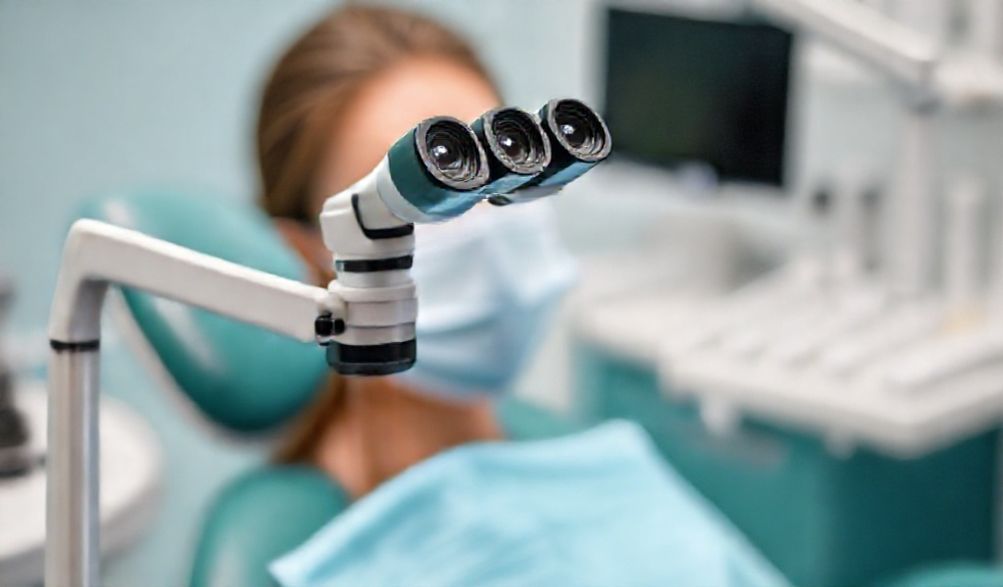
While many think of loupes simply as “magnifying glasses,” true ergonomic loupes are a sophisticated postural alignment system. They are engineered to solve the core problem described above by changing the way you see your workspace, thereby changing the way you position your body.
The Core Components: Lenses, Frame, and Declination Angle
Let’s break down the key terms:
* Magnification Power: Expressed as “2.5x,” “3.5x,” etc., this indicates how much larger an object appears. For most hygienists, a starting point between 2.5x and 3.5x offers a great balance of enlarged detail and a manageable field of view.
* Field of View: The diameter of the area you can see clearly through the lenses at a set working distance. Higher magnification typically means a smaller field of view.
* Depth of Field: The range of distance (from near to far) that remains in clear focus without needing to refocus. A good depth of field is crucial for working in the dynamic oral cavity.
* **Distancia de Trabajo:** The precise distance from your eyes to the patient’s oral cavity where the image is in perfect focus. This is measured during a fitting and is unique to your posture and arm length.
The Crucial Element: Declination Angle. This is the ergonomic heart of the system. The declination angle is the downward tilt of the loupe’s optical barrels. It is not a one-size-fits-all setting; it is meticulously calculated based on your height, torso length, and preferred working posture. A correct declination angle allows you to keep your head upright and your spine in a neutral, stacked position while your eyes are angled downward to see clearly into the mouth. Without this proper angle, you will still be forced to bend your neck.
The Science of Neutral Posture: How Loupes Re-align Your Body
Imagine two clinicians performing a mandibular anterior scaling:
* Without Loupes (or with poorly fitted ones): The clinician cranes their neck forward, rounding their shoulders and upper back to bring their eyes closer to the treatment area. The spine forms a pronounced “C” curve, compressing discs and straining muscles.
* With Properly Fitted Ergonomic Loupes: The clinician sits upright, with ears aligned over shoulders and shoulders over hips. The declination angle of the loupes directs their gaze downward into the mouth without requiring any cervical flexion. The spine remains in its strong, neutral “S” curve. The work is brought into visual clarity, not the body brought into visual compromise.
This shift from a flexed, compressed posture to an extended, neutral one is transformative. It redistributes weight properly, allows breathing muscles to function optimally, and significantly reduces the strain on postural muscles.
Key Benefits of Ergonomic Loupes for Dental Hygienists
The investment in ergonomic loupes pays dividends across multiple facets of your professional life.
Primary Benefit: Prevention of Musculoskeletal Pain and Injury
This is the most compelling return on investment. By enabling and enforcing a neutral posture, loupes directly combat the primary cause of MSDs in dentistry. They are not just a tool for seeing better; they are personal protective equipment for your spine and musculoskeletal system. Protecting your ability to work pain-free is the foundation for a long, fulfilling career.
Enhanced Visual Acuity and Precision in Procedures
Magnification reveals what the naked eye routinely misses. Subgingival calculus, especially the tenacious, glass-like deposits, becomes unmistakable. Incipient caries appear more clearly, as do craze lines, early enamel defects, and subtle changes in soft tissue texture and color. This isn’t about working harder; it’s about working smarter and more thoroughly. You can detect problems earlier, perform more complete debridement, and provide a higher standard of care with greater confidence in your work.
Reduced Eye Strain and Fatigue
Squinting and intense focusing (accommodation) for hours on end is exhausting for your ocular muscles. Loupes, especially when paired with a coaxial LED light, bring the focal point into sharp, bright, and effortless clarity. Your eyes are no longer struggling to resolve fine detail in suboptimal light, which dramatically reduces overall visual fatigue. You finish the day feeling less “eyestrain headache” and more mentally clear.
Increased Professional Confidence and Career Longevity
When you combine reduced physical pain, superior visualization, and less fatigue, you get a powerful boost in professional confidence. You feel more in control, more precise, and more capable. This confidence is palpable to patients and colleagues. Ultimately, ergonomic loupes are a cornerstone of career sustainability. They allow you to practice the meticulous, patient-centered hygiene you were trained for without sacrificing your body in the process. They are an investment in the decades of your career still to come.
How to Choose the Right Ergonomic Loupes: A Step-by-Step Guide
Selecting loupes is a highly personal process. Rushing this decision or buying based solely on price or a colleague’s recommendation can lead to an improper fit that negates the ergonomic benefits.
Step 1: Get a Professional Ergonomic Assessment
This is non-negotiable. The single most important step is to work with a knowledgeable, reputable loupes company representative or an ergonomic specialist. A proper fitting is not a 5-minute affair. It involves:
* Postural Analysis: Observing how you sit and work.
* Precise Measurement: Using tools to calculate your distancia de trabajo and the critical declination angle.
* Trial and Feedback: Allowing you to try different models and magnifications while simulating clinical movements.
A good rep will ask about your procedures, any existing pain points, and your vision. They are there to ensure the tool fits usted, not the other way around.
Step 2: Determine Your Specifications: Magnification, Field, & Working Distance
While your fitter will guide you, it helps to understand the landscape:
* Magnification: Many hygienists start with 2.5x or 3.0x. This provides a noticeable improvement in detail without too drastic a reduction in field of view or depth of field. Some experienced clinicians prefer 3.5x for periodontal work.
* **Distancia de Trabajo:** This is measured, not guessed. It ensures your instruments are in perfect focus when your elbows are at a comfortable, slightly greater-than-90-degree angle.
Step 3: Consider Key Features: Weight, Frame Style, and Light Integration
- TTL frente a Flip-Up (Abatibles): Through-the-Lens (TTL) loupes have the optics permanently mounted in the carrier lens. They are generally lighter, more stable, and offer a consistent line of sight. Flip-up loupes have a movable optical assembly. They can be flipped up when not in use, allowing for “normal” vision without removing the frame, and can sometimes be used with different frames.
- Weight & Frame: Lightweight materials like titanium are worth the investment for all-day comfort. Choose a frame style that fits your face securely without pressure points.
- The Essential Light: A coaxial LED light system is a game-changer. “Coaxial” means the light travels down the same optical path as your vision, eliminating shadows entirely. This is not an optional add-on; it is a core component of the modern ergonomic system, reducing eye strain and illuminating the fine details you’re now magnifying.
Step 4: Factor in Investment vs. Long-Term Value
Quality ergonomic loupes with a light represent a significant financial investment, often ranging from $1,000 to $2,500 or more. It’s crucial to reframe this cost. Compare it to:
* The co-pays for months of physical therapy or chiropractic care.
* The lost income from taking time off due to a back or neck injury.
* The intangible cost of chronic pain on your quality of life.
When viewed as essential, long-lasting protective equipment—comparable to a high-quality chair or ultrasonic scaler—the investment in your health, precision, and career longevity becomes clear.
Best Practices for Using and Adapting to Your Ergonomic Loupes
Your new loupes will feel different. A successful transition requires patience and mindful practice.
The Adaptation Period: What to Expect
A 1 to 2-week adjustment period is normal. You may initially feel constrained or experience slight dizziness or nausea as your brain adapts to new depth perception. The key is to move your head, not your eyes. You will learn to pivot from the neck to scan the field of view.
* Comience Despacio: Use your loupes for shorter, simpler procedures like exams and supragingival polishing during your first few days.
* Build Muscle Memory: Gradually increase usage over a week until you’re using them for all clinical procedures.
Maintaining Neutral Posture: Daily Habits and Checks
Loupes enable good posture, but you must actively maintain it.
* Chair Height: Set your stool height so your thighs are parallel to the floor and your feet are flat.
* Posición del Paciente: Don’t contort yourself. Reposition the patient—raise, lower, or tilt the chair—to bring the treatment area to you.
* The “Reset” Check: Several times a day, consciously relax your shoulders, ensure your back is against the chair support, and verify your head is upright. Let the loupes do the work.
Care and Maintenance for Longevity
Trate sus lupas como los instrumentos de precisión que son.
* Limpieza: Use solo paños de microfibra y spray específicos para lentes. Nunca use toallas de papel, ropa o productos químicos agresivos.
* Almacenamiento: Always place them in their hard case when not in use. Never leave them on a chair or counter where they can be sat on or knocked off.
* Alignment: If you drop them or notice double vision, have them checked for alignment by the manufacturer or your rep.
Frequently Asked Questions (FAQ) About Ergonomic Loupes
Q1: Are ergonomic loupes really worth the high cost for a dental hygienist?
R: Absolutely, when viewed correctly as essential protective equipment. Frame the cost against the price of physical therapy, missed work due to injury, or the long-term impact of chronic pain. The investment in your health, precision, and ability to practice for decades often pays for itself many times over.
Q2: What’s the difference between “ergonomic” loupes and regular surgical loupes?
R: While all loupes magnify, “ergonomic” loupes are specifically designed with a calculated, personalized declination angle to force a neutral spine posture. Some basic loupes may have a fixed, generic angle that doesn’t correct your posture. The ergonomic designation emphasizes the postural benefit as a primary design goal.
Q3: Can I use my existing prescription glasses with loupes?
R: Yes. Reputable manufacturers offer solutions. You can often get custom loupes with your prescription ground directly into the optical lenses (most common with TTL) or use a prescription carrier lens behind flip-up optics. Your fitter will handle this during the assessment.
P: ¿Cuánto tiempo se tarda en acostumbrarse a trabajar con lupas?
R: Most professionals adapt fully within 1-2 weeks of consistent, daily use. The key is to push through the initial unfamiliarity and trust the process. Starting with simpler tasks helps build confidence and muscle memory.
Q5: Do I still need a separate dental light if my loupes have a built-in LED?
R: They serve different purposes. A loupe-mounted light is a focused, shadow-free “headlight” that illuminates exactly where you are looking. An overhead operatory light provides general illumination for the entire oral cavity and is useful for procedures not requiring magnification. They are complementary systems for optimal visibility.
Conclusión
Ergonomic loupes are far more than a visual aid; they are a transformative tool that directly addresses the fundamental occupational hazards of dental hygiene. By promoting a neutral spine, they protect you from chronic pain and injury. By enhancing visualization, they elevate the standard of care you can provide. This dual benefit makes them one of the most significant investments a dental hygienist can make in their professional future.
Prioritizing your physical well-being through evidence-based tools like ergonomic loupes is a hallmark of a skilled, professional, and forward-thinking clinician. It demonstrates a commitment to your craft and to yourself.
Your next step is not to make an immediate purchase online, but to seek out a professional ergonomic assessment. Reach out to reputable dental loupes companies and schedule a consultation. Experience the difference a properly fitted system can make. Your neck, your back, your eyes, and your patients will thank you for years to come.
As the field of dentistry continues to evolve, the integration of ergonomics—from loupes to seating to instrument design—will remain central to building sustainable, healthy, and highly effective practices.
p>