
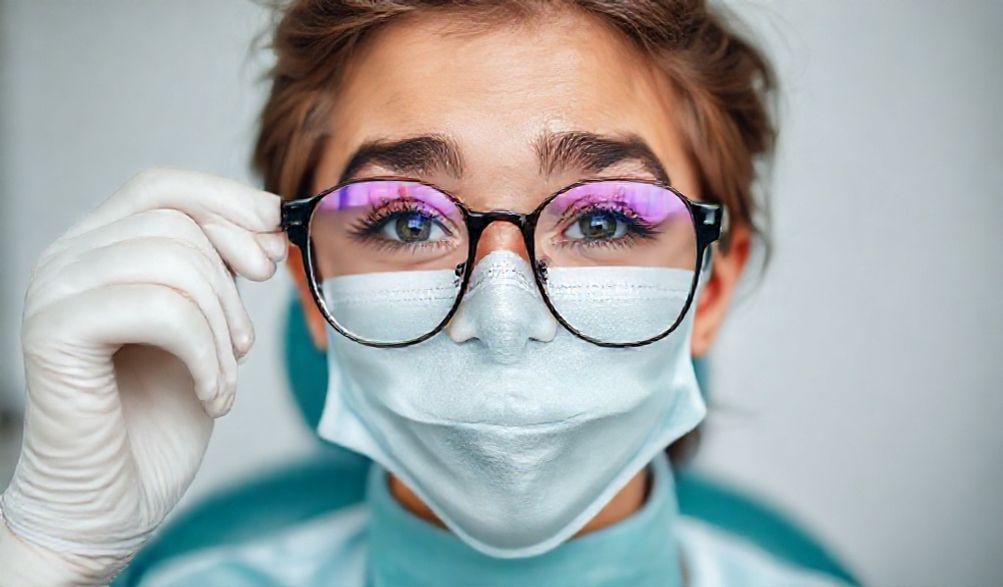
Dental Eyeglasses: A Complete Guide to Vision Protection During Dental Procedures
Have you ever left the dentist’s chair with watery, sensitive eyes from the bright overhead light? Or felt a moment of anxiety about a stray splash or particle during a cleaning? These fleeting concerns are more common than you might think. While we focus on the health of our teeth and gums, we often overlook the safety of another critical area just inches away: our eyes. In modern dental practices, patient safety is paramount, and that includes protecting one of our most sensitive organs.
The simple, effective solution is a piece of equipment you’ve likely seen but may not have thought much about: dental eyeglasses. Also known as dental safety glasses, protective eyewear, or patient glasses, these are far more than a casual accessory. They are a fundamental component of clinical best practices and infection control, designed specifically to shield your eyes in the unique environment of a dental operatory.
This complete guide will help you understand why eye protection at the dentist is non-negotiable, demystify the types of dental eyeglasses available, and walk you through what to expect. Whether you’re a patient wanting to feel more informed or simply curious about clinical safety protocols, you’ll learn how this simple tool contributes to a safer, more comfortable dental experience.
Why Eye Protection is Non-Negotiable in the Dental Chair
The dental office is a clinical environment where safety standards are rigorously upheld. Organizations like OSHA (Occupational Safety and Health Administration) mandate the use of personal protective equipment (PPE), including eye protection, for healthcare workers to minimize exposure to hazards. This principle of safety extends logically and ethically to patients. Your eyes are vulnerable during dental procedures for several concrete reasons, making protective eyewear an essential, not optional, part of your care.
Protection from Direct Splashes and Aerosols
Many routine dental procedures are not as dry as you might assume. The use of high-speed handpieces, ultrasonic scalers, air-water syringes, and polishers creates a fine mist or aerosol. This aerosol is a mixture of water, saliva, blood, tooth debris, and microorganisms. While modern dental units have high-volume suction to minimize this, splashes and airborne droplets are still a possibility. Dental eyeglasses act as a primary physical barrier, preventing this contaminated spray from coming into contact with the sensitive mucous membranes of your eyes, which could potentially lead to irritation or infection.
Shielding from Accidental Projectiles
Though dental professionals are highly skilled and precise, the mouth is a small workspace. There is a minor, but real, risk of flying debris during certain procedures. This could include a tiny fragment of an old filling, a piece of calcified tartar (calculus) during a deep cleaning, or even a small instrument. These particles, though small, can travel with enough force to cause significant corneal abrasion or injury. Safety glasses provide a shatter-resistant shield against such unexpected projectiles.
Filtering Intense Overhead Lighting
Your dentist or hygienist needs exceptional visibility to work on the minute details of your teeth. The dental operatory light is therefore extremely powerful and bright. For the patient lying directly underneath it, this can cause glare, discomfort, and light sensitivity, leading to squinting and watery eyes. Many dental eyeglasses come with a slight tint or anti-glare coating. This subtle tint filters the harshness of the light, reducing glare and allowing you to keep your eyes open and relaxed throughout your appointment, significantly enhancing comfort.
A Barrier Against Chemical Accidents
Dental treatments involve a variety of chemical agents. These can include etching gels used to prepare teeth for bonding, concentrated cleaning solutions, or bleaching agents used in whitening treatments. While great care is taken in their application, an accidental drip or splash is a possibility. Protective eyewear serves as a crucial barrier, preventing these potentially irritating or caustic chemicals from reaching your eyes.
Types of Dental Eyeglasses: Finding the Right Fit for You
Not all protective eyewear is created equal. Dental practices select from a range of options to balance protection, patient comfort, and clinical practicality. Understanding the different types can help you appreciate the thought that goes into this aspect of your care.
Standard Disposable Safety Glasses
These are the most common type patients encounter. They are lightweight, made of clear plastic, and are designed for single use. Their primary advantages are hygiene and convenience. After your appointment, they are disposed of, eliminating any cross-contamination risk. They offer basic frontal and some side protection and are perfectly adequate for most routine procedures like examinations, cleanings, and simple fillings. Their affordability allows practices to always have a fresh, clean pair on hand.
Reusable Patient Goggles with Side Shields
For enhanced protection, especially during procedures that generate more aerosols (like ultrasonic scaling), some practices use reusable safety goggles. These are made from more durable materials and are designed to be sterilized in an autoclave (a medical-grade steam sterilizer) between patients. Their key feature is a wrap-around design with integrated side shields, offering superior peripheral protection that disposable frames often lack. They provide a more secure, goggle-like fit, ensuring no gaps for splashes to enter.
Tinted or Anti-Glare Lenses
As mentioned, combating the bright operatory light is a major comfort factor. Many reusable and some disposable models come with lightly tinted lenses, typically in amber, gray, or blue. This tint cuts glare without significantly darkening your vision. Some advanced models even offer optional magnification (like low-power reading glasses), which can be a nice feature if you’d like to watch a TV screen on the ceiling or simply see what’s happening without the blur.
Specialty Frames for Children and Those with Glasses
A one-size-fits-all approach doesn’t work for eyewear. Reputable practices stock specialty frames to ensure everyone is protected comfortably.
* For Children: Pediatric dental glasses are smaller to fit little faces and often come in fun colors, patterns, or feature popular cartoon characters. This helps transform a piece of safety equipment into something cool and engaging, making children more willing to wear them.
* Over Prescription Glasses: If you wear prescription glasses, you should never be asked to remove them. Instead, the team will provide large-frame safety glasses designed specifically to fit comfortably over your regular frames. These are roomier and have longer temple arms to accommodate your glasses underneath without pinching.
What to Expect: The Patient’s Guide to Using Protective Eyewear
Knowing what will happen can ease any minor apprehension. Here’s a straightforward guide to the process of using dental eyeglasses during your visit.
When Will Your Dentist Provide Them?
You should be offered protective eyewear at the beginning of virtually any procedure where there is a potential for splashes, aerosols, or flying debris. This includes, but is not limited to:
* Professional dental cleanings (prophylaxis)
* Fillings (restorations)
* Crown and bridge preparations
* Root canal therapy
* Tooth extractions
* Deep cleanings (scaling and root planing)
If you are unsure, it’s always okay to ask, “Will I need safety glasses for this today?”
The Hygiene Protocol: How They Are Cleaned
Patient safety hinges on impeccable hygiene. The protocol depends on the type of glasses:
* Disposable Glasses: These will be provided to you in a sealed, individual plastic packet. You can witness them being opened, confirming they are new and for your use only. After your appointment, they are discarded as medical waste.
* Reusable Goggles: These undergo a rigorous sterilization process. After use, they are thoroughly cleaned and then placed in an autoclave—a device that uses high-pressure steam to kill all bacteria, viruses, and spores. They are stored in a sterile bag or container until needed for the next patient. Don’t hesitate to ask your dental team about their sterilization protocols if you have questions; a trustworthy practice will be happy to explain.
Ensuring a Comfortable and Secure Fit
Your dental assistant or hygienist will hand you the glasses and may help adjust them. They can typically bend the temple arms and adjust the nose pads for a snug, comfortable fit. A good fit is crucial—it keeps the glasses from sliding down your nose and ensures there are minimal gaps at the sides or top. If the glasses feel too tight, too loose, or if they start to fog up (a rare issue with anti-fog coatings), simply speak up. The team can readjust them or provide a different style. Your comfort is part of the safety equation.
Beyond the Patient: Eye Safety for the Entire Dental Team
A commitment to eye protection is a clinic-wide standard. The safety glasses you wear are part of a larger culture of protection that safeguards everyone in the treatment room.
Magnification Loupes for Dentists & Hygienists
You may notice your dentist or hygienist wearing what look like special glasses or visors with mounted lenses. These are surgical magnification loupes. They are not just for seeing better; they are a critical ergonomic and safety tool. By magnifying the treatment area, the clinician can see fine details with perfect posture, reducing neck and back strain. Importantly, the lenses in these loupes are also made of impact-resistant material, serving as their primary form of protective eyewear against splashes and debris.
Full-Face Shields for Major Procedures
Lors de certaines interventions générant des projections importantes ou des débris à haute vitesse – telles que certaines extractions chirurgicales ou l'utilisation de certaines pièces à main de laboratoire – le clinicien peut compléter ses loupes par une visière faciale transparente. Cela offre une protection supplémentaire pour l'ensemble du visage, illustrant davantage l'approche globale de la pratique en matière de sécurité pour tous.
Foire Aux Questions (FAQ) sur les Lunettes de Protection Dentaires
Q : Les lunettes de protection sont-elles obligatoires pour les patients ?
R : Bien que les réglementations légales de l'OSHA imposent principalement une protection pour les employés, tout cabinet dentaire respectant les normes de soins établies par les Centers for Disease Control and Prevention (CDC) et l'American Dental Association (ADA) fournira et encouragera vivement le port de lunettes de protection par les patients lors des interventions concernées. C'est un élément fondamental des protocoles modernes de contrôle des infections et de sécurité.
Q : Je porte des lunettes correctrices. Que dois-je faire ?
R : Informez toujours votre équipe dentaire que vous portez des lunettes. Elle vous fournira des lunettes de sécurité à large monture, spécialement conçues pour s'adapter confortablement par-dessus vos verres correcteurs. Vous ne devez jamais retirer vos lunettes de vue nécessaires lors d'un traitement dentaire.
Q : Puis-je refuser de porter les lunettes de protection ?
R : Vous pouvez toujours discuter de vos préoccupations avec votre dentiste. Cependant, il a l'obligation déontologique de vous informer des risques potentiels liés au renoncement à cette protection, tels que l'exposition aux aérosols, aux débris ou aux produits chimiques. Pour votre propre sécurité et confort, il est fortement recommandé d'utiliser les lunettes fournies.
Q : Comment puis-je être sûr(e) que les lunettes sont propres et sûres ?
R : Les lunettes jetables sont présentées dans un emballage scellé ouvert devant vous. Les lunettes réutilisables sont stérilisées dans un autoclave, un appareil médical garantissant une stérilité complète. Un cabinet réputé et moderne suit des cycles de stérilisation stricts et est généralement transparent sur ses processus si vous les interrogez.
Q : Les enfants doivent-ils aussi en porter ?
R : Absolument. Les yeux des enfants sont tout aussi vulnérables, sinon plus. Les cabinets dentaires pédiatriques sont bien équipés de lunettes de sécurité adaptées à leur taille, présentant souvent des designs amusants pour en faire un aspect positif de l'expérience tout en assurant leur protection.
Conclusion
Dental eyeglasses Les lunettes de protection dentaires sont bien plus qu'un simple morceau de plastique. Elles sont un élément vital et non négociable de la sécurité moderne des patients, conçues avec soin pour protéger vos yeux des éclaboussures, des aérosols en suspension, des minuscules débris et des éclairages agressifs. Cet engagement en faveur de la protection reflète le dévouement d'un cabinet à des soins complets, où votre confort et votre bien-être sont prioritaires à chaque étape.
Dans votre cabinet dentaire, ce standard de sécurité fait partie intégrante de notre mission. Fournir et utiliser des lunettes de protection est l'un des nombreux moyens par lesquels nous maintenons les normes de soins les plus élevées, vous garantissant une expérience sûre, confortable et sans anxiété. Lors de votre prochain rendez-vous, si vous avez des questions concernant les lunettes de sécurité fournies ou tout autre aspect de votre traitement, n'hésitez pas à interroger votre dentiste ou votre hygiéniste. Nous sommes là pour que vous vous sentiez informé(e), protégé(e) et en confiance dans vos soins.
p>