
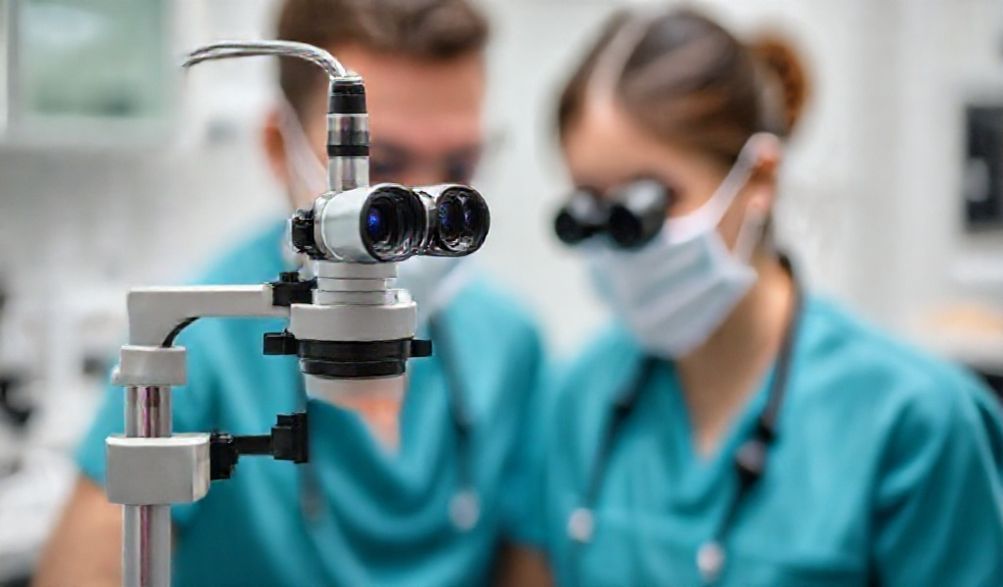
The Ultimate Guide to Loupes for Dental Assistants: Enhancing Precision, Ergonomics, and Career Growth
Introduction
Picture this: it’s 3 PM on a busy clinic day. You’ve been leaning over the chair for hours, your neck craned at an unnatural angle, squinting to see a tiny margin on a prep or to perfectly place a cord. A dull ache has settled between your shoulder blades, and your eyes feel strained and tired. This scenario isn’t just uncomfortable—it’s a daily occupational hazard for dental assistants, whose critical role demands extreme visual acuity and often comes at the cost of their musculoskeletal health.
For decades, surgical loupes were seen as the exclusive domain of the dentist. But the modern dental practice is evolving, and with it, the tools we recognize as essential for the entire clinical team. This guide serves as your comprehensive, expert-vetted resource on loupes for dental assistants. We’ve synthesized insights from seasoned dental professionals, ergonomic studies, and equipment specialists to cut through the confusion.
If you’re searching for clarity, you’re in the right place. This guide will demystify the types of loupes available, detail their transformative benefits that extend far beyond simple magnification, provide a step-by-step framework for selecting the perfect pair, and offer practical advice on justifying this investment for your long-term career health. Our goal is to empower you to make an informed, confidence-building decision that enhances your daily work and professional trajectory.
We’ll start by exploring why loupes are a true game-changer, then walk you through the selection process, key features, maintenance, and finally, answer your most pressing questions.
Why Loupes Are a Game-Changer for Dental Assistants (Beyond Just Seeing Better)
Moving from unaided vision to magnification isn’t just about seeing “bigger.” It’s about fundamentally upgrading your capability, comfort, and career sustainability. For dental assistants, loupes are less of a luxury and more of a foundational tool for professional practice.
The Core Benefits: More Than Magnification
Unmatched Visual Precision and Accuracy
The most immediate benefit is, of course, visual. Dental assisting is a world of minutiae: identifying the subtle line of a finish margin, ensuring a perfectly mixed composite without streaks, spotting a hairline fracture on an instrument, or placing a retraction cord with sub-millimeter accuracy.
- Reduced Eye Strain: Constantly focusing on tiny details from a fixed distance forces your ciliary muscles into sustained contraction, leading to fatigue, headaches, and blurred vision. Loupes bring the operative field into a relaxed, intermediate focal range, significantly reducing this muscular effort.
- Enhanced Performance: This clarity translates directly to improved performance. You can verify the cleanliness of a prep with certainty, handle and pass instruments more precisely, and monitor the oral cavity for bleeding or debris with greater confidence. This isn’t just about seeing—it’s about perceiving more, which leads to fewer errors and higher-quality support.
Revolutionary Ergonomics and Posture Protection
This is arguably the most significant, life-altering benefit for dental assistants. Chronic neck and back pain are pervasive in the profession due to the constant forward head posture and spinal flexion.
- Neutral Spine Posture: Properly fitted loupes are an ergonomic intervention. To see clearly through them, you doit sit or stand upright with your spine in a neutral position. The lenses are angled (this is the angle de déclinaison) to bring the magnified field into view when your head is in a healthy, upright posture. This single change can prevent a lifetime of pain.
- Long-Term Health Impact: By promoting this upright posture, loupes directly combat the development of musculoskeletal disorders (MSDs). They protect the cervical spine, reduce strain on the trapezius and shoulder muscles, and mitigate the risk of chronic conditions that can shorten a career. Investing in loupes is an investment in your ability to work pain-free for decades.
Enhanced Professionalism and Team Efficiency
Loupes elevate the practice of four-handed dentistry to a new level of synergy.
- Anticipatory Assistance: With a clear, magnified view of the operative site, you can anticipate the dentist’s next move more accurately. You see the same anatomy, the same moisture control challenges, and the same preparation details. This allows for seamless instrument transfer, efficient suctioning, and proactive support without the need for verbal cues.
- Workflow Integration: This shared visual perspective streamlines procedures, reduces chair time, and minimizes stress for both the provider and the patient. It positions you as a true co-therapist, enhancing your value and professionalism within the practice.
Addressing Common Misconceptions and Objections
“Aren’t Loupes Just for Dentists?”
This is a persistent myth. While dentists were early adopters, the principle applies to anyone performing precision visual tasks. The dental assistant’s role is profoundly visual—from charting to lab work to direct clinical support. Loupes are a tool for précision, and precision is required at every stage of patient care. Embracing them reframes the assistant’s role as that of a skilled technical expert.
“They’re Too Expensive for My Role.”
Viewing loupes as a mere expense is a short-term perspective. Reframe it as a strategic investment with a tangible return:
* Investment in Health: The cost of physical therapy, chiropractic care, or chronic pain management far exceeds the one-time cost of loupes. They are preventive healthcare for your career.
* Investment in Skill: Enhanced precision makes you a more competent and confident assistant, increasing your value to any employer.
* Investment in Longevity: By preserving your physical well-being, you protect your ability to work in a clinical setting long-term.
When broken down over a 5-10 year career, the cost-per-use is minimal, especially when weighed against the benefits.
How to Choose the Right Loupes: A Dental Assistant’s Step-by-Step Guide
Selecting loupes is a personal process, but understanding the technical aspects will guide you to the perfect fit.
Key Technical Specifications Demystified
- Magnification Power (2.0x, 2.5x, 3.0x, etc.): More power isn’t automatically better. Higher magnification narrows the field of view and reduces depth of field. For most dental assistants, a power between 2.5x and 3.5x is the ideal starting range. It provides a significant visual boost for tasks like mixing, cord packing, and instrument inspection while maintaining a manageable field of view for dynamic clinical environments. Start conservatively; you can always move to higher power later.
- Field of View and Depth of Field: Think of Champ de vision as the width of the magnified “window” you see through. A wider field is helpful for maintaining situational awareness. Depth of Field is the range of distance that remains in clear focus. A greater depth of field allows you to move instruments slightly closer or farther without losing focus, which is crucial during live procedures.
- Distance de travail : This is the critical measurement from your eyes (specifically, the corneal plane) to the patient’s mouth where the image is in perfect focus. It is determined by your posture, arm length, and how you position yourself at the chair. This measurement is why a professional fitting is non-negotiable. An incorrect working distance will force you back into poor posture, completely negating the ergonomic benefit.
The Great Debate: Galilean vs. Prismatic (Through-the-Lens) Loupes
- Galilean Loupes: These use a simple lens system (like binoculars). They are generally plus légers, plus compacts et moins chers. They offer excellent clarity and are sufficient for the magnification ranges most assistants need (up to about 3.5x). Their field of view is typically wider.
- Prismatic Loupes: These use a more complex Porro prism system. They can achieve higher magnification levels (3.5x and above) with a longer working distance and superior depth of field. However, they are heavier, bulkier, and more expensive.
Recommendation: For the vast majority of dental assistants entering the world of magnification, a well-fitted Galilean system (2.5x-3.5x) provides the perfect balance of performance, comfort, and value.
Frame, Fit, and Comfort: The Personalization Factor
The technical specs are useless if the loupes are uncomfortable.
* Frame Styles: You can choose through-the-lens (TTL), where the optical barrels are fixed to the lens of the frame, or un design, where the magnification unit flips up when not in use. TTL models are often lighter and provide a more consistent optical path, while flip-ups offer flexibility to quickly look at something unmagnified.
* The Fitting is Everything: This cannot be overstated. A reputable vendor will conduct a comprehensive fitting to measure your pupillary distance (PD), determine your ideal typique et un angle de déclinaison, and ensure the frame sits comfortably on your nose and ears. Never buy loupes online without these professional measurements. A poor fit is a wasted investment.
Top Features and Add-Ons to Consider for Your Practice
Integrated LED Lighting: Is It Worth It?
A coaxial LED light (mounted between the optical barrels) casts shadow-free illumination directly into your field of view.
* Avantages : Eliminates shadows from overhead lights, dramatically improves contrast and clarity, especially in posterior regions, and reduces eye strain further.
* Inconvénients : Adds weight to the front of the frame, requires battery management (rechargeable packs are standard), and increases cost.
* Verdict: For assistants heavily involved in direct clinical procedures like restorative or surgical assisting, integrated lighting is a highly valuable upgrade. For those focused more on lab work or sterilization, it may be less critical.
Lens Coatings and Customization
- Traitements : Anti-reflective coating reduces glare from operatory lights. Anti-fog coating is essential to prevent lens fogging during patient exhalation. Blue light filter coatings can help reduce digital eye strain if you also view monitors.
- Verres Correcteurs : If you wear glasses, you have options. Prescription can be ground directly into the loupe optics (for TTL models) or you can order a custom carrier lens. Some flip-up models can be worn over your regular glasses, though this can be bulkier.
Durability, Warranty, and Service Support
Loupes are a precision instrument. Look for a manufacturer that offers a substantial warranty (often 2-5 years on optics and 1 year on frames/parts). Inquire about their repair process and turnaround time. A company with strong customer service and educational support is a valuable partner.
Maximizing Your Investment: Use, Care, and Justification
Proper Use and Adjustment Techniques
When you first get your loupes, there will be an adaptation period. Start by wearing them for 30-60 minutes at a time during less critical tasks to build hand-eye coordination. Ensure the frame is adjusted so the weight is evenly distributed between your nose and ears. The image should be clear and singular without eye strain.
Cleaning and Maintenance Best Practices
Un entretien approprié prolonge la durée de vie de votre investissement.
1. Always use the provided microfiber cloth or lens-specific wipes.
2. Ne jamais use your scrub top, paper towel, or harsh chemicals (like alcohol or window cleaner), as they can damage coatings.
3. For smudges, use a drop of lens cleaner or lukewarm water with a mild soap.
4. Store them in a hard case when not in use.
How to Present the Case to Your Employer
De nombreuses cabinets sont ouverts à parrainer ou subventionner des loupes pour leur équipe. Formulez votre demande autour de du retour sur investissement pour le cabinet:
* **Efficacité accrue :** “ Avec une meilleure visibilité, je peux anticiper les besoins plus rapidement et assister plus efficacement, ce qui peut réduire la durée des interventions. ”
* **Précision améliorée :** “ Le grossissement m'aidera à garantir des mélanges de matériaux parfaits et à assister avec une plus grande précision, réduisant ainsi les risques d'erreurs. ”
* **Ergonomie et fidélisation de l'équipe :** “ Il s'agit d'un investissement dans ma santé à long terme et ma carrière au sein de ce cabinet. Réduire mon risque de blessure liée au travail signifie que je pourrai être un membre productif de l'équipe pour les années à venir. ”
* **Développement professionnel :** “ J'investis dans mes compétences pour fournir le plus haut niveau de soutien à nos médecins et à nos patients. ”
Proposez de partager les informations que vous avez apprises. Certains cabinets proposent une allocation ou un programme de cofinancement pour l'équipement professionnel.
Foire Aux Questions (FAQ)
**Q1 : Quel est le fourchette de prix typique pour une bonne paire de loupes pour assistant dentaire ?**
**R :** Vous pouvez vous attendre à une fourchette allant d'environ 300 € pour un système Galiléen de base et bien conçu à à 1 200 € et plus pour un système prismatique à fort grossissement avec éclairage intégré et revêtements premium. L'assistant moyen trouvera d'excellentes options entre 500 € et 800 €.
**Q2 : Puis-je acheter des loupes en ligne, ou ai-je besoin d'un ajustement ?**
**R :** Nous recommandons fortement un ajustement professionnel en personne. Bien que vous puissiez acheter en ligne, les mesures critiques pour la distance de travail, l'angle de déclinaison et la distance pupillaire sont extrêmement difficiles à prendre soi-même avec précision. Un ajustement inapproprié compromettra la posture et le confort, rendant les loupes inefficaces, voire néfastes.
Q : Combien de temps faut-il pour s'habituer à porter des loupes ?
**Q3 : Combien de temps faut-il pour s'adapter aux loupes ?** **R :** La plupart des utilisateurs s'adaptent en. 1 à 2 semaines.
. Commencez par les porter pendant de courtes périodes lors de tâches familières pour développer une nouvelle coordination main-œil. Votre cerveau a besoin de temps pour s'adapter au monde grossi et à focale fixe. La persévérance est la clé.
**Q4 : Existe-t-il des options de loupes abordables ou d'entrée de gamme de bonne qualité ?** **R :** Absolument. Plusieurs marques réputées proposent des systèmes de loupes Galiléennes d'entrée de gamme offrant une excellente clarté optique et un bénéfice ergonomique à un prix inférieur. N'oubliez pas qu'une loupe de base, correctement ajustée, est infiniment meilleure que pas de loupe du tout.
ou qu'une loupe chère mais mal ajustée.
**Q5 : Les loupes sont-elles compatibles avec mes verres correcteurs ?**.
Conclusion
**R :** Oui. Vous avez deux options principales : 1) Faire tailler votre correction directement dans les verres des loupes (la solution la plus intégrée et la plus nette), ou 2) Utiliser un système de loupes à relevage que l'on peut porter par-dessus ses lunettes habituelles. Discutez des deux options avec votre représentant en loupes. Choisir d'investir dans des loupes est l'une des décisions les plus impactantes qu'un assistant dentaire puisse prendre pour sa carrière. C'est un engagement qui porte ses fruits en termes de **bien-être physique** en protégeant votre posture, en termes de **compétence clinique** en aiguisant votre précision visuelle, et en termes de **statut professionnel**.
en rehaussant votre rôle au sein de l'équipe dentaire.
N'oubliez pas qu'il ne s'agit pas d'un achat à précipiter. Il mérite une recherche attentive, des consultations avec vos pairs et vos mentors, et, surtout, un ajustement professionnel dédié auprès d'un fournisseur de confiance. Les bonnes loupes doivent être comme un prolongement naturel de vos sens.
Passez à l'étape suivante. Contactez des entreprises réputées de matériel dentaire pour planifier une consultation. Parlez à des collègues de votre réseau qui utilisent des loupes et interrogez-les sur leur expérience. Voyez et ressentez la différence par vous-même.
p>