
Operating Room Lights: A Comprehensive Guide to Surgical Lighting Technology
Imagine a cardiac surgeon performing a delicate coronary artery bypass. Their hands move with practiced precision, navigating a landscape of intricate tissue and minute vessels. In this high-stakes environment, a single visual misinterpretation—a shadow obscuring a suture line, a color distortion masking tissue oxygenation—can have profound consequences. This scenario underscores a truth often overlooked by those outside the surgical suite: the operating room (OR) light is not mere illumination; it is a fundamental, life-enabling medical device.
This guide provides a detailed, authoritative overview of operating room lights—exploring their technology, key features, types, selection criteria, and maintenance—to inform healthcare professionals, facility managers, and procurement specialists. Compiled with reference to industry standards like IEC 60601-2-41, peer-reviewed principles of medical engineering, and expert clinical insights, this post is designed to ensure accuracy and trustworthiness. Whether you are specifying a new surgical suite, upgrading existing equipment, or seeking to optimize your clinical environment, this resource will help you understand critical specifications, make informed purchasing decisions, and ultimately, ensure the foundation for optimal surgical performance and patient safety.
The Critical Role of Surgical Lighting in Modern Healthcare
In the modern OR, lighting transcends its basic function. It is a pivotal component of the surgical ecosystem, directly influencing outcomes, ergonomics, and infection control protocols.
Impact on Surgical Outcomes: Reducing Error and Fatigue
The primary objective of surgical lighting is to create an optimal visual field that allows the surgeon to see minute details with clarity, accuracy, and minimal strain. This directly impacts two key areas: error reduction and surgeon fatigue.
- Visual Acuity and Precision: A high-quality light provides intense, homogeneous illumination that penetrates deep into body cavities without creating harsh shadows at the hands or instruments. This shadow reduction is crucial for depth perception and spatial orientation, allowing for more precise dissection and suturing. Studies in surgical ergonomics have linked poor lighting to increased visual strain and procedural error rates.
- Surgeon Stamina: Glare, “hot spots” (areas of excessive brightness), and poor color rendering force the surgeon’s eyes to constantly adjust, leading to significant eye fatigue and headaches over long procedures. By delivering consistent, diffuse light with excellent color fidelity, advanced OR lights help maintain a surgeon’s visual comfort and concentration throughout lengthy operations, directly contributing to sustained performance and reduced cognitive load.
Beyond Illumination: Lighting as Part of the Sterile Field
An OR light is a physical object intruding into the sterile zone. Its design, therefore, must adhere to the same rigorous principles of asepsis that govern all surgical equipment.
- Gestion thermique : Traditional halogen and metal halide lights emitted substantial infrared radiation, generating significant heat at the surgical site. This could lead to tissue desiccation (drying out) and increased patient discomfort. Modern LED-based systems produce dramatically less radiant heat, keeping the surgical field cooler and safer.
- Contrôle des infections : Light heads and handles are frequently touched by sterile personnel. Their design must be seamless, without crevices or joints that can harbor pathogens. Materials must withstand repeated cleaning and disinfection with harsh chemicals like hydrogen peroxide without degrading. The shape often allows for easy draping with sterile plastic covers, integrating the light fully into the aseptic field.
Key Technologies and Features of Modern OR Lights
The evolution from simple incandescent bulbs to today’s sophisticated systems represents a leap in medical engineering. Understanding the core technologies is essential for evaluation.
LED Technology: Efficiency, Longevity, and Cooler Operation
Light Emitting Diode (LED) technology has revolutionized surgical lighting, rendering older systems nearly obsolete.
- Advantages over Halogen/Metal Halide: LEDs are far more energy-efficient, converting a higher percentage of electricity into visible light. They have an exceptionally long lifespan (often 50,000+ hours), eliminating frequent, costly bulb changes and reducing OR downtime. Most critically, LEDs emit minimal infrared radiation, solving the historic problem of tissue heating. They also offer instant, flicker-free illumination at full intensity.
Color Temperature and Rendering Index (CRI)
Accurate color perception is non-negotiable in surgery. Differentiating between arterial blood, venous blood, fatty tissue, and organ parenchyma relies on subtle hue variations.
- Color Temperature (4000K-5000K): Measured in Kelvin (K), this describes the “warmth” or “coolness” of light. Surgical lights typically emulate “cool white” or “daylight” (4000K-5000K). This spectrum provides a bright, alerting quality that enhances contrast and reduces the yellowish tint that can distort tissue appearance.
- Color Rendering Index (CRI >90): CRI measures a light source’s ability to reveal the true colors of objects compared to natural light. A CRI above 90 (on a scale of 0-100) is considered excellent and is the standard for OR lights. A high CRI ensures that a surgeon’s visual assessment of tissue viability, oxygenation (cyanosis), and perfusion is accurate.
Depth of Illumination and Homogeneous Light Field
These are perhaps the most defining technical performance metrics.
- Depth of Illumination (DoI): This refers to the light’s ability to provide adequate brightness deep within a wound cavity (e.g., during spinal or pelvic surgery). It is a measure of the light’s penetrating power without a corresponding increase in surface glare. Advanced optical systems using multiple LED arrays and specialized reflectors/ lenses achieve superior DoI.
- Homogeneous Light Field: A perfect surgical light would produce a perfectly even circle of light with no central hot spot or dim edges. In reality, engineers aim for maximum homogeneity. This is typically expressed as a percentage (e.g., “60% homogeneity”) within a defined central field. High homogeneity eliminates distracting brightness gradients, reducing eye strain.
Handling Systems: Ceiling-Mounted, Track, and Portable
How the light is positioned is as important as the light itself.
- Ceiling-Mounted (Single-Point): The most common type, suspended from a single arm attached to the ceiling. It offers excellent maneuverability and a large range of motion but is fixed to one location in the OR.
- Track-Mounted: The light travels along a ceiling-mounted rail system. This provides unparalleled flexibility to position the light anywhere along the track’s length, ideal for multi-purpose ORs or rooms where the table position may vary. It also allows for multiple light heads on the same track.
- Portable (Floor-Stand): Mobile units on wheeled bases. These are vital for minor procedure rooms, emergency situations, or as supplementary lighting in major ORs. They offer complete flexibility but occupy floor space.
Types of Operating Room Lights and Their Applications
OR lights are categorized by their intended use, which dictates their size, power, and feature set.
Major Surgical Lights (Primary Lights)
These are the workhorses of the main operating theater, designed for complex, long-duration procedures.
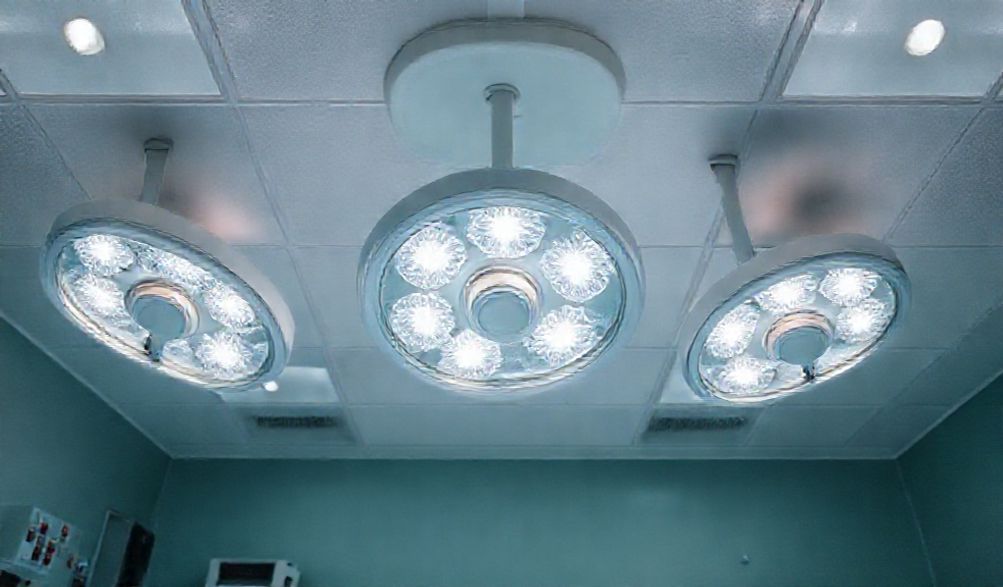
- Description : Typically large systems with multiple light heads (often 4 to 8 or more LED modules arranged in a circular “cluster”). This multi-spot design is key to creating deep shadow reduction—as a hand or instrument blocks one light path, the others fill in the gaps.
- Applications: Major open procedures: cardiovascular, major abdominal (e.g., Whipple procedure, liver resection), transplant, orthopedic (joint replacement), and neurosurgery.
- Caractéristiques : High lumen output (often 160,000+ lux at 1m), exceptional depth of illumination, sophisticated handle controls, and often integrated camera ports.
Minor/Specialty Procedure Lights
Smaller, more agile lights designed for less invasive or shorter procedures.
- Description : Usually feature one or two light heads on a simpler arm. They are lighter and easier to position precisely.
- Applications: Outpatient surgery, endoscopic suites, plastic surgery, minor orthopedic procedures (e.g., hand surgery), labor & delivery, and emergency rooms.
- Caractéristiques : Sufficient intensity for surface or shallow-cavity work, often with a smaller field diameter, and may include battery backup for portability.
Examination Lights and Hybrid Systems
These serve supplemental roles within the surgical environment.
- Examination Lights: Simple, single-head lights used in patient prep areas, scrub bays, or for secondary illumination. They lack the intensity and homogeneity of major lights.
- Hybrid/Integrated Boom Systems: Increasingly common, these combine a surgical light with other critical utilities on a single ceiling-mounted boom. A boom might hold the primary light, an endoscopic camera display, and equipment for suction, insufflation, and power. This consolidates technology, clears floor space, and improves workflow by bringing everything to the surgical field.
How to Choose the Right Operating Room Lights: A Buyer’s Guide
Selecting OR lights is a significant capital investment. A structured evaluation framework is essential.
Assessing Clinical Needs and Surgical Specialties
Begin with a clinical audit. What procedures are performed in each room?
* High-Acuity ORs: For cardiac, neuro, or major trauma, prioritize lights with the highest depth of illumination, redundancy (multiple independent LED drivers), and superior homogeneity.
* Multipurpose ORs: A versatile major light with a track system may offer the best adaptability.
* Specialty Rooms (Ophthalmic, Endoscopic): These may require lights with specific color-tuning capabilities or smaller, more precise light heads.
Understanding Technical Specifications: A Checklist
Convert clinical needs into technical requirements. Key specs to compare include:
* Éclairement : Measured in lux (lumens/m²) at a standard distance (e.g., 160,000 lux at 1 meter). Ensure it meets or exceeds recommended levels for the planned procedures.
* Diamètre du champ : The size of the illuminated circle at the working distance. A larger diameter is needed for open abdominal surgery than for microsurgery.
* Depth of Illumination: A critical metric for deep-cavity work. Request test data or demonstrations.
* Redundancy & Battery Backup: If one LED module or driver fails, does the light maintain adequate illumination? A battery backup ensures functionality during a power interruption, crucial for patient safety.
Ergonomics and Workflow Integration
The best light is useless if it’s difficult or unsterile to use.
* Ease of Positioning: The balance of the arm, the smoothness of movement, and the ability to lock position precisely are subjectively vital. Request hands-on demos by surgeons and nurses.
* Poignées Stériles : Handles must be designed for easy draping or be made of sterilizable material. Controls should be intuitive to use through a drape.
* System Integration: Does the light have ports for mounting a 4K camera? Is it compatible with the hospital’s existing OR integration or video recording systems?
Ne vous fiez pas uniquement au prix d'achat. Calculez le
Look beyond the purchase price.
* Initial Cost vs. Long-Term Savings: While LED lights have a higher upfront cost, their 50,000+ hour lifespan and ~60% lower energy consumption lead to substantial savings over 5-10 years compared to halogen systems.
* Maintenance Costs: Inquire about service contracts, the cost and frequency of filter replacements, and the local availability of technical support.
Installation, Maintenance, and Safety Standards
OR lights are regulated medical devices. Their safe and effective operation depends on proper installation and upkeep.
Compliance with Medical Device Regulations
In the U.S., OR lights are FDA Class II medical devices. Globally, they must comply with the IEC 60601 series of standards for medical electrical equipment, with Part 2-41 (IEC 60601-2-41) providing particular requirements for surgical luminaires. Compliance ensures electrical safety, mechanical safety, and performance accuracy.
Proper Installation and Calibration
Installation is not a task for general contractors. It must be performed by the manufacturer’s certified technicians or highly trained biomedical engineers. Ceiling structures must be assessed for load-bearing capacity. Post-installation, the light must be calibrated to ensure the light field is centered, homogeneous, and meets its specified output ratings.
Protocoles de nettoyage de routine et de maintenance préventive
- Daily/Cleaning: Light heads and handles should be cleaned after each procedure according to the manufacturer’s instructions, using approved disinfectants that won’t damage lenses or coatings.
- Preventative Maintenance: Scheduled PM should include checking arm tension and movement, verifying illumination levels and color metrics with a light meter, cleaning internal air filters (critical for thermal management of LEDs), and inspecting all safety features. An annual professional service is typically recommended.
Common Troubleshooting and Service
Common issues include reduced intensity (often dirty filters or aging LEDs), stiff arm movement (requiring re-balancing), or failure to hold position. A robust service agreement with guaranteed response times is a wise investment for mission-critical equipment.
The Future of Surgical Lighting
The OR light is evolving from a passive illuminator into an intelligent, connected node in the digital operating room.
Integration with Digital OR and Imaging Systems
The next generation of lights are “imaging-ready.” They feature:
* Built-in 4K/8K Cameras: Offering a pristine, sterile overhead view for recording, tele-mentoring, and teaching.
* Augmented Reality (AR) Overlays: Potential for projecting pre-operative imaging data (e.g., tumor margins, vessel paths) directly onto the surgical field through the light optics.
* Seamless Connectivity: Integration with OR integration systems (ORiS) to control lights, cameras, and displays from a single touchscreen or voice command.
Smart Lighting and Automation
- Voice Control & Presets: Surgeons may adjust light position or intensity hands-free. Preset “scenes” could be recalled for specific procedure phases (e.g., “initial incision,” “deep cavity,” “closing”).
- Data Logging: Lights could log usage patterns, performance metrics, and maintenance alerts, feeding into predictive maintenance schedules.
Advances in LED Technology and Sustainability
- Ajustement spectral : Des LED capables d'ajuster leur émission spectrale pour améliorer le contraste de tissus spécifiques (par exemple, mettre en évidence les canaux biliaires ou les glandes parathyroïdes) sont en cours de développement.
- Efficacité accrue : Les gains continus en lumens par watt réduiront davantage la consommation d'énergie et la production de chaleur.
- Durabilité : Une durée de vie plus longue et une utilisation réduite de l'énergie diminuent l'empreinte environnementale des soins chirurgicaux, tandis que des conceptions facilitant le recyclage des composants émergent.
Foire Aux Questions (FAQ)
Quelle est la durée de vie typique des lampes chirurgicales à LED ?
Les lampes chirurgicales LED modernes ont une durée de vie typique de 50 000 à 60 000 heures. Avec une utilisation normale en salle d'opération (environ 2 000 heures par an), cela correspond à plus de 25 ans de service avant une baisse significative du flux lumineux, dépassant de loin les technologies plus anciennes.
À quelle fréquence les lampes de salle d'opération doivent-elles être entretenues ou étalonnées ?
Les fabricants recommandent généralement une maintenance préventive complète et un contrôle d'étalonnage par un technicien qualifié au moins une fois par an. Le nettoyage quotidien et la vérification visuelle du fonctionnement relèvent de la responsabilité du personnel de la salle d'opération.
Les anciens systèmes d'éclairage chirurgical halogène peuvent-ils être mis à niveau vers la LED ?
Dans de nombreux cas, oui. Plusieurs fabricants proposent des kits de modernisation LED pour leurs anciens systèmes halogènes. Cela peut être un moyen rentable de bénéficier des avantages de la technologie LED (fonctionnement plus frais, économies d'énergie) sans le coût complet d'un nouveau système de lampe et de bras. Une évaluation professionnelle est nécessaire pour déterminer la compatibilité.
Quelle est la caractéristique la plus importante à rechercher dans une lampe de salle d'opération ?
Bien que toutes les caractéristiques soient importantes, la profondeur d'éclairage combinée à une haute homogénéité est souvent considérée comme la mesure de performance la plus critique. Elle détermine directement la capacité du chirurgien à voir dans les plaies profondes sans ombres ni points chauds, impactant la précision et la sécurité.
Comment nettoyer et désinfecter correctement une tête de lampe chirurgicale ?
Suivez toujours les Instructions d'Utilisation (IFU) spécifiques du fabricant. Généralement, cela implique d'utiliser un chiffon doux humidifié avec un désinfectant de bas niveau de qualité hospitalière, approuvé pour les matériaux de la lampe. Évitez les nettoyants abrasifs, les solvants ou de pulvériser du liquide directement sur la tête de lampe, surtout près des évents ou des joints. Laissez sécher à l'air.
Existe-t-il des lampes spécifiques recommandées pour la neurochirurgie ou la chirurgie ophtalmique ?
Oui. Ces spécialités nécessitent souvent des lampes offrant une profondeur et une homogénéité exceptionnelles pour les cavités profondes (neurochirurgie) ou une intensité très élevée avec un minimum de chaleur pour les travaux microscopiques (ophtalmologie). Certaines lampes ophtalmiques proposent une température de couleur ajustable pour optimiser le contraste lors des interventions rétiniennes. Consulter les chirurgiens de ces spécialités et les fabricants disposant de gammes de produits dédiées est essentiel.
Conclusion
L'évolution de la lampe de salle d'opération – d'un simple projecteur à un dispositif médical intégré sophistiqué – reflète les progrès de la chirurgie elle-même. Elle est passée d'un simple rôle de visibilité à un système technologique critique qui améliore activement la sécurité des patients, la précision chirurgicale et les résultats cliniques. Son rôle dans la réduction de la fatigue visuelle, la différenciation précise des tissus et l'intégration dans le champ stérile est fondamental pour les soins chirurgicaux modernes.
Investir dans un éclairage chirurgical de haute qualité et l'entretenir méticuleusement n'est pas un luxe optionnel ; c'est un composant non négociable d'une pratique chirurgicale efficace et fondée sur des preuves. Cette décision, ancrée dans le besoin clinique et l'excellence technique, soutient directement l'équipe chirurgicale dans son travail le plus vital.
Appel à l'action : Nous encourageons les responsables d'établissements de santé, les gestionnaires de salles d'opération et les ingénieurs cliniques à consulter des ingénieurs biomédicaux certifiés et des fabricants réputés pour réaliser une évaluation approfondie des besoins de leurs blocs opératoires. Privilégiez les évaluations pratiques et la formation du personnel à l'utilisation et à la maintenance appropriées. Pour une liste de contrôle détaillée afin de guider votre processus de spécification, envisagez de contacter un expert du secteur de confiance pour un audit spécifique à votre établissement.
p>