
Hospital Lighting: A Guide to Healing Environments, Safety, and Compliance
Light is a fundamental force of life. It governs our biological clocks, influences our mood, and shapes our perception of the world. Now, consider this: what if the lighting in a hospital could directly influence patient recovery, staff well-being, and clinical outcomes? The answer, supported by a growing body of evidence, is that it does. Far from being a mere utility, hospital lighting is a critical, yet often underestimated, component of healthcare infrastructure. It is a powerful therapeutic tool, a vital safety system, and a key factor in operational efficiency.
This guide moves beyond basic illumination to explore the sophisticated, multifaceted role of light in healthcare settings. Synthesizing insights from healthcare design principles, clinical research, and stringent facility management standards, we provide a comprehensive resource for healthcare administrators, facility managers, architects, and design professionals. We will delve into how lighting impacts patient healing and staff performance, unpack the critical safety and regulatory standards that govern it, and examine the practical considerations for modern design and technology selection. Understanding hospital lighting is not just about choosing fixtures; it’s about engineering an environment that actively promotes health.
The Critical Role of Lighting in Healthcare Environments
In a hospital, every element of the built environment sends a message. Lighting, perhaps more than any other feature, communicates whether a space is for healing, for high-stakes intervention, or for rest. Its role extends far beyond simply allowing people to see.
Beyond Illumination: Lighting as a Therapeutic Tool
Modern healthcare lighting design is rooted in a holistic understanding of patient needs. It recognizes that the visual environment can either support or hinder the healing process.
- Impact on Recovery: Studies have shown that access to natural light and well-designed artificial lighting can lead to reduced patient recovery times and shorter lengths of stay. Patients in sunlit rooms have been reported to experience less stress and require fewer pain medications.
- Regulating Circadian Rhythms: Our sleep-wake cycles are governed by circadian rhythms, which are highly sensitive to light. In environments like Intensive Care Units (ICUs) or long-term care facilities, where patients may be disconnected from natural day-night cycles, inappropriate lighting can cause severe circadian disruption. This “circadian chaos” is linked to delirium, poor sleep, and slower recovery. Therapeutic lighting aims to reinforce a healthy rhythm, providing bright, blue-enriched light during the day and warm, dim light at night.
- Psychological Well-being: Harsh, flickering, or gloomy lighting can exacerbate anxiety and depression. Conversely, thoughtful lighting that mimics nature, reduces glare, and offers patient control can create a more calming, less institutional atmosphere, directly benefiting mental health.
Supporting Clinical Staff: Accuracy, Safety, and Well-being
The demands on healthcare professionals are immense, and lighting is a silent partner in their performance. Inadequate lighting is a contributor to eye strain, fatigue, and error.
- Reducing Fatigue: Nurses and doctors working long, irregular shifts are particularly vulnerable to the effects of poor lighting. Glare on computer screens, insufficient task lighting, and constant adaptation between bright and dark spaces cause visual fatigue, which compounds overall tiredness and can impact judgment.
- Enabling Visual Acuity: Clinical tasks demand precision. Whether it’s reading a patient’s chart, assessing a wound’s true color and condition, differentiating vein colors for cannulation, or performing a delicate surgical procedure, proper illumination is non-negotiable. The right light level, color quality, and direction are essential for accuracy.
- Promoting Safety and Morale: A well-lit environment is a safer environment. It helps staff navigate quickly, identify potential hazards, and perform protocols correctly, thereby reducing the risk of medical errors. Furthermore, a workspace with good lighting that supports circadian health can improve staff alertness, mood, and overall job satisfaction.
Creating a Healing Environment for Visitors and Families
Hospitals are stressful for loved ones, too. Lighting plays a key role in shaping their experience.
- Intuitive Wayfinding: Clear, consistent lighting can guide visitors intuitively. Highlighted pathways, illuminated signage, and distinct lighting in key areas (e.g., reception, waiting areas, cafeterias) reduce confusion and anxiety in an often-disorienting building.
- Welcoming Public Spaces: Waiting rooms and lobbies should feel welcoming, not sterile. Using warmer color temperatures, incorporating indirect lighting to soften shadows, and creating visual interest with light can make these spaces feel less stressful and more supportive for anxious families.
Key Standards and Safety Regulations for Hospital Lighting
Hospital lighting is governed by a complex web of codes and standards. Compliance is not optional; it is a fundamental requirement for patient safety, infection control, and operational licensure.
Navigating Essential Compliance: NFPA, IEC, and Joint Commission Guidelines
- NFPA 70: National Electrical Code (NEC): This is the baseline for all electrical installations in the United States. It includes specific articles on healthcare facilities (Article 517), mandating requirements for wiring methods, grounding, and the separation of emergency power systems. Understanding these codes is essential for any retrofit or new construction.
- IEC 60601 Series: For any lighting integrated with or near medical electrical equipment (like an MRI-compatible light or a surgical light), international standards like IEC 60601-1 apply. They ensure the device does not interfere with sensitive equipment and is safe for use in the patient vicinity.
- The Joint Commission (TJC) and Other Accreditors: Accreditation bodies survey facilities against standards that include the physical environment. Lighting factors into life safety (egress lighting), infection control (cleanable surfaces), and the overall care environment. Non-compliance can impact a hospital’s accreditation status.
Infection Control and Cleanability
In healthcare, every surface is a potential reservoir for pathogens. Lighting fixtures must be designed accordingly.
- Fixture Design: In high-risk areas like operating theaters, isolation rooms, and cleanrooms, fixtures must be completely sealed, with smooth, non-porous surfaces that can withstand frequent and aggressive cleaning with disinfectants. Designs should avoid dust-collecting ledges, seams, and grilles.
- IP Ratings: The Ingress Protection (IP) rating indicates a fixture’s resistance to solids and liquids. In areas subject to wash-down (e.g., sterile processing, certain bathrooms), fixtures with a high IP rating (e.g., IP65) are required to prevent water ingress and damage.
Emergency and Egress Lighting Requirements
When primary power fails, lighting becomes a critical life-safety system.
- Mandated Backup: Codes strictly mandate automatic emergency lighting in corridors, stairwells, exit paths, and other critical care areas. This system must activate within 10 seconds of a power outage.
- Exit Signs: Illuminated exit signs with battery backup are required at all exits and along the egress path.
- Generator Power: Essential areas like operating rooms, ICUs, and emergency departments are typically on emergency generator circuits to ensure life-support and critical procedure lighting remains operational.
Designing a Hospital Lighting Scheme: Areas of Application
A one-size-fits-all approach fails in a hospital. Each area has unique functional and human needs that must be addressed by the lighting design.
Patient Room Lighting: Balancing Comfort and Care
The patient room is a bedroom, a examination room, and a living space. Its lighting must be layered and flexible.
- General Ambient Lighting: Provides overall, shadow-free illumination. It should be dimmable to accommodate day and night.
- Examination Lighting: A high-output, color-accurate light, often mounted on a ceiling track or articulated arm, for clinical assessments by staff.
- Patient-Created Lighting: A personal, controllable reading light and often an over-bed light with separate controls allows the patient to adjust their immediate environment without disturbing a roommate.
- Circadian Support: The ideal modern solution is a tunable white system that can change its color temperature from a cool, alerting white (~4000K) during the day to a warm, relaxing white (~2700K) in the evening.
Surgical Suite and Procedure Room Lighting
Here, lighting is a precision instrument.
- Surgical Lights: These provide intense, shadow-reduced illumination directly into deep cavities. Key features include high Color Rendering Index (CRI), the ability to maintain color temperature as they dim, and sterilization-friendly surfaces.
- Ambient Room Lighting: Provides general illumination for setup, cleanup, and when the surgical light is not in use. It must integrate seamlessly with the surgical system and support a sterile field.
Diagnostic and Imaging Areas (MRI, Radiology)
Lighting must not interfere with sensitive technology.
- MRI Suites: All fixtures, wiring, and components within the MRI scanner room must be non-ferrous (non-magnetic) to prevent dangerous projectile hazards and shielded to avoid radio frequency interference (RFI) that can distort images.
- Radiology Reading Rooms: Lighting must be carefully controlled to eliminate glare on high-resolution diagnostic monitors. Dimmable, indirect lighting is standard to prevent eye strain during long image review sessions.
Corridors, Nurses’ Stations, and Common Areas
These connective and functional spaces have distinct needs.
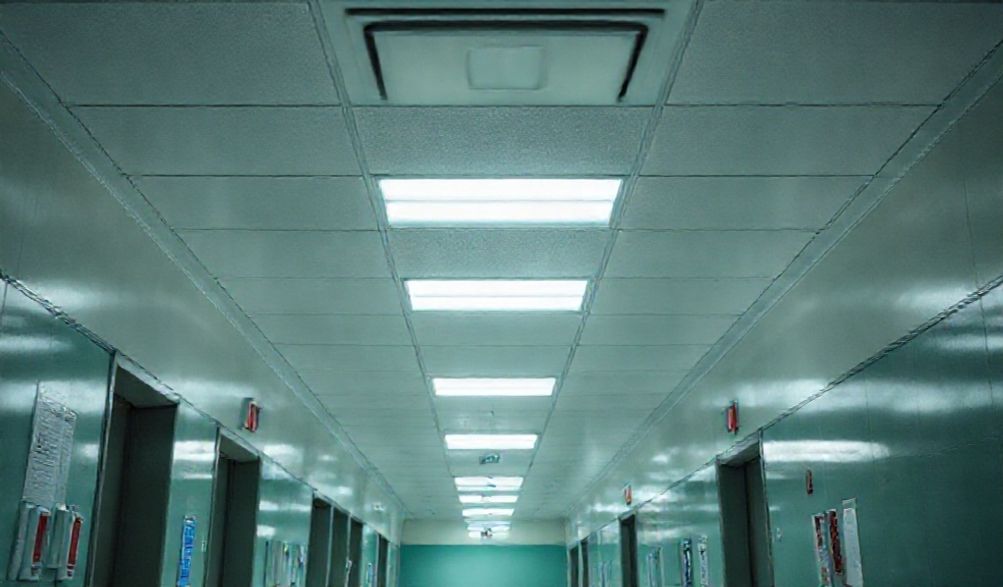
- Corridors: Require uniform, consistent illumination for safe patient transport, wayfinding, and fall prevention. Nighttime settings should provide lower, warmer light levels for quiet periods.
- Nurses’ Stations: Need a combination of ambient light and high-quality task lighting for computer work, paperwork, and communication, all while minimizing glare and screen reflections.
- Waiting Areas: Should employ warmer color temperatures and softer, often indirect, lighting to create a less clinical, more calming atmosphere for visitors.
Technology and Innovation in Modern Hospital Lighting
Advancements in lighting technology are revolutionizing what’s possible in healthcare environments, offering unprecedented control, efficiency, and therapeutic benefits.
The LED Revolution: Benefits for Healthcare
Light Emitting Diode (LED) technology is now the standard, and for good reason:
- Energy Efficiency & Longevity: LEDs consume significantly less power than fluorescent or halogen sources and have lifespans exceeding 50,000 hours, drastically reducing maintenance costs and bulb replacement in hard-to-reach areas.
- Performance Control: They are inherently dimmable and generate very little radiant heat, improving patient and staff comfort, especially in exam rooms.
- High CRI: LEDs can be engineered with a very high Color Rendering Index (CRI >90), which is crucial for accurate clinical observation of skin tones, tissue health, and bodily fluids.
Human-Centric Lighting (HCL) and Tunable White Systems
This is lighting designed around human biological needs.
- Concept: HCL systems dynamically adjust light intensity and color temperature throughout the day to mimic the natural progression of sunlight, actively supporting circadian rhythm regulation.
- Use Cases: Particularly transformative in areas like Neonatal ICUs (to help pre-term infants develop circadian rhythms), Dementia Care Units (to reduce sundowning agitation), and Psychiatric Facilities (to support mood and sleep patterns).
Smart Lighting Systems and IoT Integration
Lighting is becoming an intelligent part of the building’s nervous system.
- Sensors & Controls: Occupancy and vacancy sensors can automatically turn lights off in unoccupied rooms, saving energy. Light sensors can adjust artificial light based on available daylight (daylight harvesting).
- Building Integration: Smart lighting systems can be integrated with the Building Management System (BMS) for centralized control and data collection. There is also potential for integration with nurse call systems—for example, a patient’s room light could gently pulse when a nurse is being called to provide a visual cue.
UV-C Disinfection Lighting: Applications and Safety Protocols
Ultraviolet-C (UV-C) light is a proven technology for air and surface disinfection.
- Application: UV-C fixtures are used for terminal room disinfection after a patient is discharged, targeting high-touch surfaces and the air to supplement manual cleaning. They are also used in air handling units to treat circulating air.
- Critical Safety Warning: UV-C radiation is extremely hazardous to skin and eyes. Its use mandates strict safety protocols: it must only operate in unoccupied rooms with interlocked door and motion sensors that immediately shut it off if someone enters. Staff require specialized training. It is a powerful tool, but it is a supplement to—not a replacement for—standard cleaning procedures.
Frequently Asked Questions (FAQ) About Hospital Lighting
What is the ideal color temperature (Kelvin) for a general patient room?
There is no single “ideal” static temperature. The best practice is to use a tunable white system. This allows the lighting to be programmed to a cooler, more alerting white (~4000K) during daytime hours to support activity and circadian rhythms, and then gradually shift to a warmer, relaxing white (~2700K-3000K) in the evening to promote rest and sleep.
How does lighting help reduce patient falls?
Proper lighting is a key fall prevention strategy. It ensures even, shadow-free illumination along all pathways, especially from the bed to the bathroom. Installing low-level, warm-toned nightlights (e.g., in baseboards or step lights) provides enough guidance for nighttime trips without creating bright light that fully wakes the patient or disrupts their sleep cycle.
Are there specific lighting requirements for behavioral health units?
Yes, requirements are stringent and focus on safety and well-being. Fixtures must be ligature-resistant (no exposed cords, tamper-proof, and designed to prevent anything from being attached). They must be incredibly durable. The quality of light is also vital: warm, indirect lighting that minimizes glare and flicker is used to create a calming atmosphere. All components are typically secured behind unbreakable lenses.
What are the most important factors when retrofitting an older hospital with LED lighting?
1. Electrical Compatibility: Ensure existing wiring and control systems are compatible with LED drivers. Retrofits may require rewiring or new control interfaces.
2. Flicker-Free Performance: Specify medical-grade, flicker-free LEDs to prevent headaches and eye strain.
3. High CRI: Choose LEDs with a CRI of 90+ for accurate clinical observation.
4. Code Compliance: The retrofit must bring the lighting system up to current NEC and life safety codes.
5. Safe Disposal: Plan for the proper, environmentally sound disposal of old fluorescent tubes, which contain mercury.
Who should be involved in planning a new hospital lighting design?
A successful design requires a multidisciplinary team: Healthcare architects and interior designers, electrical engineers, facility managers and directors of engineering, infection control preventionists, and—critically—clinical staff representatives (nurses from various units, surgeons, and therapists). Their firsthand experience is invaluable for creating a functional, human-centered design.
Conclusion
Hospital lighting has evolved from a basic utility to a sophisticated, integral component of patient care and facility operation. It is a therapeutic tool that can shorten recovery times, a safety system that prevents errors and falls, and an operational asset that improves staff well-being and reduces energy costs. Investing in thoughtful, evidence-based lighting design is an investment in the core mission of healthcare: healing.
Looking ahead, we can expect even greater integration, with lighting systems incorporating biometric sensors and using artificial intelligence to create truly adaptive environments that respond in real-time to the needs of occupants.
Ultimately, implementing effective hospital lighting requires expertise. It is strongly advised to partner with lighting designers and consultants who specialize in the healthcare sector and possess a deep understanding of the latest research, innovative technologies, and the ever-evolving landscape of codes and standards. The goal must always be to create a safe, efficient, and profoundly healing-centric environment, where light itself becomes a part of the care team.
Call to Action: Consider the lighting in your facility. Does it actively support healing and safety, or is it merely functional? Begin by conducting a lighting audit or making human-centric lighting a priority in your next renovation or building project. Start the conversation with the people who matter most—your patients and staff—and build your plan from there.
p>