
The Complete Guide to LED Examination Lamps: Benefits, Features & Selection
Introduction
In the precise world of healthcare, from a routine physical to a complex dental restoration, one factor remains constant: the critical need for exceptional illumination. The quality of light directly influences diagnostic accuracy, procedural efficiency, and patient comfort. For decades, clinics and operating rooms relied on the warm, intense glow of halogen lamps or the diffuse light of fluorescents. Today, a technological revolution has quietly set a new standard. Light Emitting Diode (LED) examination lamps are no longer a novelty; they are the modern benchmark for clinical lighting, offering a transformative combination of performance, efficiency, and reliability.
This guide is designed to be your definitive, unbiased resource. Whether you are a physician, dentist, veterinarian, clinic manager, or procurement specialist, navigating the specifications and claims of various LED exam lights can be daunting. Our purpose is to demystify the technology, translate the technical jargon into clinical benefits, and provide a clear framework for evaluation. We will synthesize engineering principles with practical clinical needs, empowering you to make an evidence-based investment that enhances patient care, supports your staff, and improves your practice’s operational sustainability for years to come.
What is an LED Examination Lamp? Defining the Modern Standard
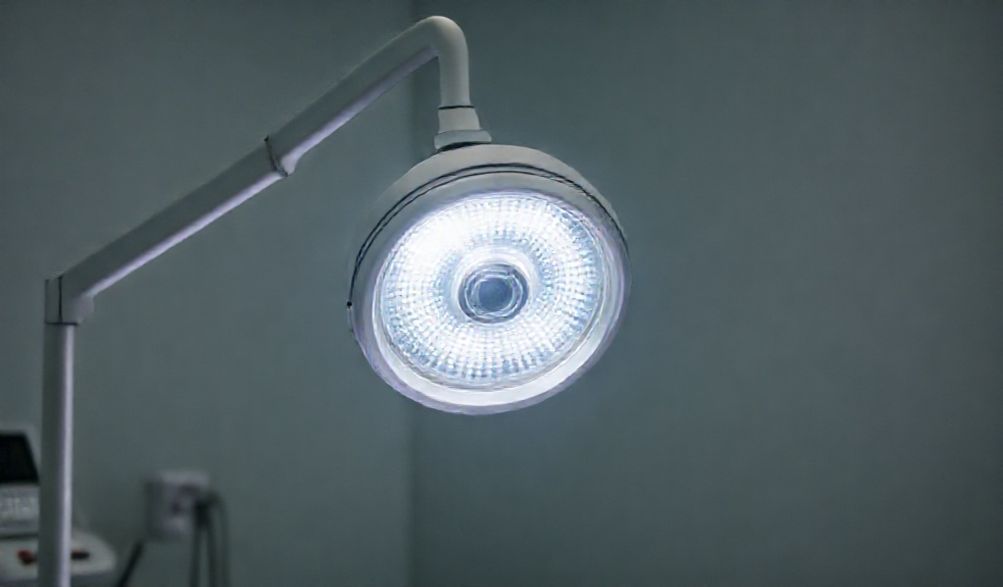
An LED examination lamp is a specialized medical lighting device that utilizes an array of Light Emitting Diodes (LEDs) as its light source. It is engineered to provide intense, consistent, and color-accurate illumination for diagnostic and procedural tasks across medical, dental, and veterinary fields. Unlike a standard room light, it is a precision tool designed for clarity, control, and clinician comfort.
Core Technology: How LED Lighting Differs from Traditional Sources
The fundamental shift lies in the light source itself. Traditional halogen lamps work by heating a tungsten filament until it glows white-hot, producing light as a byproduct of significant heat. Fluorescent lights pass an electrical current through a gas, causing a phosphor coating to glow.
LED technology is fundamentally different. It is a solid-state device where light is emitted from a semiconductor material when an electrical current passes through it. This core difference unlocks key advantages:
- Efficiency: LEDs convert a much higher percentage of electrical energy directly into light, not heat. This means more lumens per watt.
- Longevity: With no fragile filament or gas to degrade, LEDs have a typical lifespan of 30,000 to 50,000 hours—dwarfing the 1,000-2,000 hours of a halogen bulb.
- Durability: The solid-state construction makes LEDs highly resistant to shock and vibration.
- Instant Performance: LEDs reach full brightness immediately, with no warm-up time, and can be dimmed smoothly without color shift.
Primary Applications in Healthcare Settings
The precision of LED lighting makes it indispensable across diverse clinical environments:
- General Patient Examinations (Primary Care, Pediatrics, ENT): For assessing skin conditions, throat, ears, eyes, and general physical signs with true color fidelity.
- Dentistry: Essential for illuminating the dark, confined oral cavity with shadow-free light during examinations, cavity preparation, and restorative procedures.
- Dermatology & Aesthetics: Critical for evaluating skin lesions, pigmentation, and vascular structures under accurate color representation.
- Minor Surgery & Procedure Rooms: Providing bright, focused, and cool illumination for wound closure, biopsies, and other minor surgical interventions.
- Veterinary Medicine: Used for examinations and procedures on animals, often requiring robust construction and greater reach.
Key Benefits of Upgrading to an LED Examination Light
Moving to an LED system is not merely a bulb replacement; it’s an upgrade in clinical capability. The benefits are tangible and directly impact daily practice.
Enhanced Visual Accuracy for Diagnoses
This is the most significant clinical benefit. LED lamps excel in two key light quality metrics:
* High Color Rendering Index (CRI): A CRI of >90 (where 100 is perfect sunlight) ensures that the colors of tissue, skin, blood, and mucosa are rendered authentically. This allows for precise differentiation between healthy and inflamed tissue, accurate assessment of jaundice or cyanosis, and correct shade matching in dentistry.
* Adjustable Color Temperature: The ability to tune the light from a warm (~4000K) to a cool (~6000K) white lets clinicians match the light to the task. A neutral white (~4500K) is often preferred as it reduces eye strain and provides optimal contrast.
Together, these features minimize diagnostic uncertainty and contribute directly to improved patient outcomes.
Superior Shadow Control & Adjustable Focus
Shadows can obscure critical details. Advanced LED exam lamps combat this through optical engineering:
* Multi-Point LED Arrays: Instead of a single point source (like a halogen filament), LEDs are arranged in a ring or matrix. This multi-directional approach fills in shadows created by the clinician’s head or instruments.
* Frosted Lenses & Diffusers: These scatter the light, creating a softer, more even field of illumination that penetrates cavities like the mouth or a wound without harsh edges or dark spots.
* Adjustable Beam Diameter: A focusable spot-to-flood beam allows the clinician to concentrate intense light on a small area or spread it for a broader examination.
Cooler Operation & Enhanced Patient Comfort
Halogen lamps are notorious for their radiant heat, which can be uncomfortable for patients during lengthy procedures and poses a risk of drying tissue or even causing thermal injury. LEDs emit minimal infrared radiation. The light head remains cool to the touch, enhancing patient comfort and safety, especially in sensitive fields like pediatrics, dentistry, and dermatology.
Long-Term Cost Efficiency & Sustainability
The financial argument for LED is compelling when viewed through the lens of Total Cost of Ownership (TCO):
* Energy Savings: LEDs consume 50-80% less electricity than equivalent halogen systems. For a lamp used several hours daily, this adds up to substantial savings on utility bills.
* Elimination of Bulb Replacements: With a lifespan measured in decades under normal use, the cost and hassle of frequent halogen bulb purchases and changes are removed.
* Reduced Maintenance & Downtime: The robust LED design and lack of a fragile filament mean fewer failures and less clinical downtime.
This makes the LED lamp a sustainable choice, reducing both operational costs and environmental impact.
Critical Features to Consider When Choosing a Lamp
Understanding these specifications will allow you to compare products objectively and select a lamp that meets your clinical demands.
Light Quality Metrics: CRI, CCT, and Luminance
- Color Rendering Index (CRI): Aim for CRI ≥95 for the most critical color discrimination. Never settle below 90 for medical use.
- Correlated Color Temperature (CCT): Measured in Kelvin (K). Adjustability between 4000K-6000K is ideal. A fixed 4500K “neutral white” is an excellent standard.
- Luminance (Illuminance): The amount of light falling on a surface, measured in Lux (lx) or foot-candles (fc). For detailed medical tasks, >40,000 lux at the focal point is a common benchmark, with higher values needed for surgery. Ensure the light is even across the field, not just bright in the center.
Mechanical Design: Flexibility and Sterility
- Articulation & Reach: The lamp should have multiple, tension-adjustable joints (often 4 or 5) to position the light head exactly where needed without drifting. Consider the “reach” from its mount to your typical examination point.
- Mounting Options: Choose based on your room layout and workflow.
- Ceiling Mount: Maximizes floor space, offers the widest range of motion.
- Wall Mount: A space-saving alternative with good coverage.
- Floor Stand: Portable and flexible, ideal for multi-room use or clinics with limited ceiling/wall options.
- Table/Clamp Mount: For smaller, specialized setups.
- Cleanability: Surfaces should be seamless and non-porous, capable of withstanding frequent wiping with hospital-grade disinfectants. Look for anti-microbial coatings on handles and arms.
Durability, Safety & Certifications
These are non-negotiable for patient and staff safety.
* Medical Device Certifications: The lamp must be certified as a medical device. Look for:
* CE Marking under EU MDR (Medical Device Regulation) for Europe.
* FDA 510(k) Clearance or Listing for the United States.
* Ingress Protection (IP) Rating: Indicates protection against dust and liquids. An IPX4 rating or higher (protection against water splashes from any direction) is advisable for clinical environments.
* Electrical Safety: Compliance with IEC 60601-1 (the international standard for medical electrical equipment) is essential.
How to Select the Right LED Exam Lamp for Your Practice
With the technical foundation laid, here’s how to apply this knowledge to your specific situation.
Matching the Lamp to Your Medical Specialty
- General Practice / Family Medicine: Prioritize a wide, even field of light with excellent CRI for whole-body assessments. Easy, smooth maneuverability and a simple interface are key for fast-paced exams. A floor stand or ceiling mount often works well.
- Dentistry: Requires extremely high luminance (often 50,000+ lux) and exceptional shadow control to see deep into the oral cavity. A focused, smaller beam diameter is typical. Look for lamps designed specifically for dental ergonomics, often with a cool, blue-tinted “daylight” mode for composite work.
- Surgery (Minor/Assist): Demands the highest intensity and most uniform field with virtually no shadows. Sterility is paramount—ensure handles can be covered with sterile sleeves or are easily disinfected. A ceiling-mounted surgical light is standard, but high-end procedural LED headlights are also common.
- Veterinary Medicine: Needs robust construction to withstand a less controlled environment. Extra reach and articulation are helpful for positioning around animals. Portable floor stands are highly valuable.
Evaluating Total Cost of Ownership (TCO)
Look beyond the initial price tag. A simple 5-year TCO analysis should include:
1. Purchase Price: The invoice cost.
2. Energy Cost: (Wattage ÷ 1000) * Hours of daily use * Days per year * Electricity cost per kWh * 5 years.
3. Maintenance/Bulb Cost: For LED, this is typically $0 for bulbs. Factor in any potential service contracts.
A slightly more expensive, high-quality LED lamp with a 10-year warranty will almost always have a lower TCO than a cheaper, less efficient alternative.
Vendor Selection and Trial Considerations
- Reputation & Support: Research the manufacturer’s history in medical lighting. Read reviews from similar practices.
- Warranty: A minimum 5-year warranty on the LED module and moving parts is a sign of quality and confidence.
- In-Practice Trial: This is the most critical step. Always request a demo unit. Use it in your actual workspace for several days. Assess its ease of use, light quality on real patients, stability, and noise. Does it integrate seamlessly into your workflow?
Frequently Asked Questions (FAQ)
Q1: Are LED examination lamps really worth the higher upfront cost compared to halogen?
A: Absolutely. While the initial investment is often higher, the long-term savings on energy and replacement bulbs, coupled with the clinical benefits of better light quality and cooler operation, typically result in a positive return on investment within 1-3 years. The improved diagnostic capability and patient comfort provide additional, invaluable value.
Q2: What does a “high CRI” mean, and why is it medically important?
A: CRI (Color Rendering Index) measures a light’s ability to reveal the true colors of objects compared to natural light. A high CRI (>90, ideally >95) is crucial in medicine to accurately assess skin tones, tissue health, inflammation, bruising, and capillary refill. It reduces eye strain and leads to more confident, accurate diagnoses.
Q3: How do I properly clean and maintain an LED examination lamp?
A: Always follow the manufacturer’s instructions. Generally, use a soft, lint-free cloth lightly dampened with a mild disinfectant or isopropyl alcohol (70%). Avoid abrasive cleaners, aerosols, or spraying liquid directly onto joints, lenses, or vents. Wipe down handles and arms after each patient. Periodically check the tension in the arms to ensure smooth, drift-free movement.
Q4: Can the light intensity be adjusted, and is a “cool” or “warm” white light better?
A: Most quality LED exam lamps offer fully dimmable intensity. The ideal color temperature is often a matter of preference, but a neutral white (around 4500K) is widely recommended. It provides a balance that minimizes eye fatigue for the clinician over long periods and offers excellent color accuracy. Adjustable CCT allows you to tailor the light to specific tasks.
Conclusion
Selecting an LED examination lamp is a strategic decision that reverberates through every aspect of your practice. It directly influences the accuracy of your diagnoses, the ergonomics and efficiency of your procedures, your facility’s operating costs, and, ultimately, the experience and safety of your patients. This guide has provided the framework to move beyond marketing claims and evaluate these tools based on their clinical performance and long-term value.
We encourage you to prioritize the needs of your specialty, demand the certifications that ensure safety, and calculate the true cost of ownership. Investing in advanced LED lighting is not just an equipment purchase; it is an investment in the quality, precision, and future-readiness of the care you provide. Your next step is to use these criteria to shortlist products from reputable suppliers and insist on a hands-on, in-clinic trial. See the difference for yourself.
p>