
A Comprehensive Guide to Operating Room Overhead Lights: Technology, Selection & Safety
Introduction
In the high-stakes environment of the modern operating room (OR), every piece of equipment plays a role in the delicate ballet of surgery. Among the most critical, yet sometimes overlooked, is the operating room overhead light. Far more than simple illumination, these sophisticated devices—often termed surgical luminaires—are engineered instruments of precision. Their primary function is to provide a clear, shadow-free, and cool view of the surgical site, a requirement that directly impacts procedural accuracy, surgeon stamina, and, most importantly, patient outcomes.
Choosing the right operating room overhead lights is not a matter of simple procurement; it is a strategic investment in clinical excellence. A subpar lighting system can lead to eye strain, misinterpretation of tissue, and prolonged procedure times. Conversely, an advanced system enhances visualization, reduces errors, and supports the entire surgical team’s ergonomics.
This comprehensive guide delves into the essential technology behind these vital tools, outlines key considerations for selection and maintenance, and underscores their pivotal role in upholding the highest standards of patient care and surgical efficiency. We will synthesize insights from clinical studies, manufacturer specifications, and healthcare facility guidelines to provide a trustworthy, in-depth resource for clinical engineers, OR managers, and healthcare administrators.
The Critical Role of Surgical Lighting in Modern Healthcare
Beyond Illumination: Impact on Surgical Precision and Outcomes
The fundamental purpose of operating room overhead lights is to enable the surgeon to see. But “seeing” in surgery is a complex sensory task that requires optimal conditions. The quality of light directly influences a surgeon’s ability to differentiate between subtle tissue types, identify delicate structures like nerves and blood vessels, and perceive depth within a cavity.
- Tissue Differentiation: High-fidelity color rendering is paramount. The ability to distinguish arterial red from venous blue, healthy pink tissue from necrotic or ischemic areas, relies on the light source accurately representing the full spectrum of colors. Poor lighting can lead to misinterpretation, increasing the risk of iatrogenic injury.
- Surgical Accuracy and Speed: Clinical observations and studies have consistently shown a correlation between optimal lighting and reduced procedural error rates. A clear, bright, and homogeneous light field allows for more precise incisions, suturing, and dissection. Furthermore, when surgeons are not struggling against glare or shadows, procedures can often be completed more efficiently, potentially reducing anesthesia time and improving OR turnover.
Enhancing the Surgical Team’s Performance and Ergonomics
The benefits of advanced operating room overhead lights extend beyond the surgical site to the well-being of the surgical team.
- Reducing Fatigue: Surgeons often perform lengthy, intricate procedures requiring intense visual concentration. Glare from reflective instruments or wet surfaces, coupled with inadequate or “hot” lighting, causes significant eye strain and visual fatigue. Modern LED systems with advanced optics minimize glare and emit virtually no infrared radiation, keeping the surgical field cool and reducing thermal discomfort for both patient and staff.
- Supporting Ergonomic Posture: The maneuverability of the light head is crucial. A light that is difficult to position or that requires the surgeon to contort their body to avoid casting a shadow can lead to musculoskeletal strain over time. Smooth, responsive positioning systems with long reach and multiple axes of movement allow the surgeon to place the light perfectly without compromising their own posture.
Core Technology & Key Features of OR Overhead Lights
Understanding the technical specifications is key to evaluating operating room overhead lights. These metrics define the quality and capability of the illumination provided.
Understanding Light Quality Metrics: Lux, Color Temperature, and CRI
- Lux (Illuminance): This measures the amount of light (luminous flux) falling on a surface. For surgery, the required lux level varies by procedure. Deep-cavity procedures (e.g., cardiac, pelvic) may require 160,000 lux or more at the center of the field, while surface-level surgery might be adequately served by 40,000-80,000 lux. The light must maintain a high percentage of this central intensity across a defined field diameter (e.g., 25cm).
- Color Rendering Index (CRI): Perhaps the most critical metric for surgery, CRI measures a light source’s ability to reveal the true colors of objects compared to natural light. A CRI of 100 is perfect sunlight. For surgical applications, a CRI of 90 or higher is essential. This ensures accurate differentiation of tissue types, fluid colors, and organ states.
- Color Temperature: Measured in Kelvin (K), this describes the “warmth” or “coolness” of the light’s appearance. surgical lights typically offer adjustable color temperatures, often between 4000K (neutral white) and 5000K (cool white). Some surgeons prefer a cooler light for enhanced contrast, while others may choose a warmer tone for reduced eye strain during long procedures.
Shadow Management and Homogeneous Light Fields
The term “shadow-free” is a defining goal of surgical lighting. It is achieved through sophisticated optical engineering:
- Multi-Point Light Source Technology: Instead of a single bulb, modern operating room overhead lights use an array of numerous LEDs arranged in a specific pattern. When a surgeon’s hand or instrument obstructs one LED, the others fill in the gap, dramatically reducing the density and obstruction of the shadow.
- Parabolic Reflectors and Optical Systems: The light from each LED is carefully directed and blended using specially designed reflectors and lenses. This creates a deep, homogeneous light field where the intensity is evenly distributed, eliminating “hot spots” and ensuring consistent illumination across the entire surgical cavity.
Advanced LED Systems: Benefits and Long-Term Value
The shift from halogen to LED has revolutionized surgical lighting, offering tangible benefits:
- Energy Efficiency & Longevity: LEDs consume significantly less power and have a lifespan of 50,000-60,000 hours, compared to 1,000-2,000 hours for halogen bulbs. This drastically reduces energy costs, replacement frequency, and maintenance labor.
- Performance Advantages: LEDs offer “instant-on” at full intensity, with no warm-up time. They are highly dimmable without color shift. Most importantly, LEDs emit minimal infrared (heat) radiation, protecting delicate tissues and improving comfort.
- Total Cost of Ownership (TCO): While the initial investment in high-quality LED operating room overhead lights may be higher, the long-term savings in energy, bulb replacements, and associated downtime make them a more cost-effective solution over the system’s lifespan.
Essential Considerations for Selecting Operating Room Lights
Selecting the right system requires a needs assessment that goes beyond technical specs.
Assessing Your OR’s Specific Needs: Procedure Types and Room Layout
- Surgical Specialty: A high-volume orthopedic OR performing joint replacements may prioritize a different light (perhaps with broader coverage) than a neurosurgery suite requiring intense, focused light for deep brain work. Consider if your facility needs general-purpose lights or specialized systems for cardiac, ophthalmology, or plastic surgery.
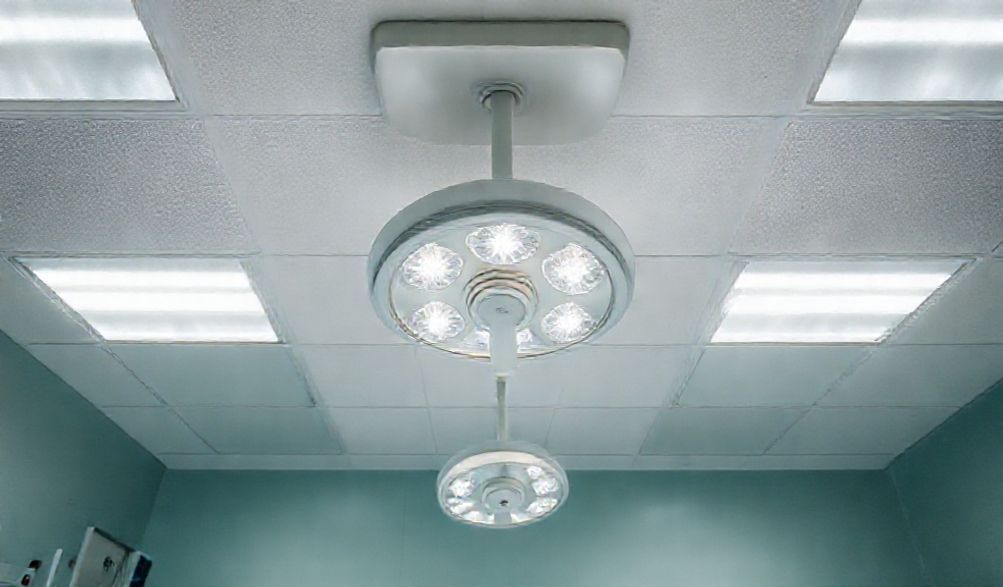
- Configuration: Will a single large light head suffice, or is a multi-light configuration (e.g., two independent lights on a common boom) needed for complex, multi-disciplinary procedures? The choice between ceiling-mounted fixed arms, track-mounted systems for lateral movement, and floor-standing booms depends on room size, ceiling height, and workflow.
Sterility, Maintenance, and Infection Control Compliance
The design of operating room overhead lights must support a sterile environment.
- Cleanability: Surfaces should be seamless, non-porous, and resistant to hospital-grade disinfectants. Handle design is critical—they must be easily removable for sterilization or be seamlessly sealed. The absence of crevices where contaminants can accumulate is a must.
- Serviceability: A clear preventive maintenance schedule from the manufacturer is vital. Components like filters (for cooling systems) should be easily accessible for replacement by clinical engineering staff. Reliability and ease of service minimize OR disruptions.
Integration with OR Infrastructure and Technology
The modern OR is a digitally integrated environment. Lighting should be a part of this ecosystem.
- Hybrid ORs: In rooms equipped with fixed imaging systems like CT or angiography C-arms, the operating room overhead lights must be able to retract fully out of the way without impeding imaging. Some systems offer “imaging mode” settings that adjust light color to not interfere with camera systems.
- OR Control Systems: Integration allows lights to be controlled from a central touch panel or wall switch, alongside room lights, HVAC, and audiovisual equipment. Advanced systems may offer programmable presets for different procedure types.
Safety, Standards, and Regulatory Compliance
As medical devices, operating room overhead lights are subject to stringent regulations.
Adherence to Medical Device Regulations (FDA, CE, ISO 60601-2-41)
- ISO 60601-2-41: This is the paramount international standard specifically for the basic safety and essential performance of surgical luminaires. It covers requirements for light output, color rendering, shadow dilution, temperature rise, mechanical strength, and electrical safety.
- Certifications: Purchasing from manufacturers with FDA clearance (USA), CE marking (Europe), and other relevant regional certifications is non-negotiable. This ensures the device has been tested and validated to perform safely and effectively.
Routine Inspection, Preventive Maintenance, and Quality Assurance
Compliance doesn’t end with purchase. A robust maintenance program is essential.
- Key Checks: Clinical engineering teams should perform scheduled checks on light intensity (lux), color temperature, CRI, and mechanical functions (brake strength, smoothness of movement). Any degradation in performance must be addressed promptly.
- Documentation: All maintenance, repairs, and performance validations should be meticulously documented to meet Joint Commission, AORN, and other accreditation body standards, and to ensure a reliable audit trail.
The Future of Surgical Lighting: Trends and Innovations
The evolution of operating room overhead lights is moving towards greater intelligence and specialization.
Smart Lighting and Integration with Digital ORs
- Automation and Control: Future systems will feature more automated presets—a “cardiac preset” could automatically adjust intensity, color temperature, and field size. Voice control and gesture recognition will enhance sterile maneuverability.
- Data Integration: Imagine lights that adjust based on the step of a surgical procedure outlined in the digital patient record, or that interface with surgical navigation systems to highlight specific anatomical areas.
Specialized Lighting for Advanced Procedures
- Minimally Invasive Surgery (MIS): Lights are being designed with specific beam angles and intensities to optimally illuminate the external field during laparoscopic or robotic procedures, where the primary view is via a monitor.
- Enhanced Visualization: Research is ongoing into lights that can excite fluorescent dyes used to identify cancerous tissues, map lymph nodes, or assess tissue perfusion in real-time, moving lighting from a passive illuminator to an active diagnostic aid.
FAQ Section
Q1: What is the typical lifespan of modern LED surgical lights?
A: High-quality LED operating room overhead lights often have a rated lifespan of 50,000 to 60,000 hours. This translates to over a decade of typical OR use, significantly reducing replacement frequency and long-term operational costs compared to traditional halogen bulbs.
Q2: How often should surgical overhead lights be serviced or calibrated?
A: Manufacturers typically recommend scheduled preventive maintenance by qualified clinical engineers every 6 to 12 months. This includes performance verification and mechanical inspection. OR staff perform daily visual checks and cleaning according to facility protocol.
Q3: Can surgical lights be adjusted during a procedure without breaking sterility?
A: Absolutely. Modern systems are designed for sterile interaction. This is achieved through removable, sterilizable handles; touchless infrared or proximity sensors on the light head; or integration with voice control systems and sterile foot pedals.
Q4: What does “shadow-free” light really mean in an OR context?
A: “Shadow-free” refers to technology that minimizes obstructive shadows to the point of being non-disruptive. Through multi-source LED arrays and precision optics, high-quality systems reduce shadow density (the darkness of a shadow) to very low levels (e.g., <10%) as defined by the ISO 60601-2-41 standard, effectively eliminating problematic shadows in the critical surgical cavity.
Q5: Are there specific lights for different surgical specialties?
A: While versatile general-purpose lights exist, many specialties benefit from optimized features. Neurosurgery and ophthalmology often require lights with exceptionally high intensity and small, precise spot sizes. Hybrid ORs need lights with superior retraction capabilities. Some manufacturers offer specialty-specific models or configurable light heads to meet these nuanced demands.
Conclusion
Operating room overhead lights represent a vital fusion of medical necessity and advanced engineering. They are a foundational pillar of the surgical environment, directly enabling precision, safety, and efficiency. The selection process must therefore be meticulous, balancing core performance features—superior light quality measured by CRI and lux, effective shadow management, ergonomic design, and robust construction—with the practical demands of sterility, maintenance, and integration.
By viewing this decision as a strategic investment rather than a simple purchase, healthcare facilities empower their surgical teams with the clearest possible view of the operative field. This commitment to optimal visualization is a direct commitment to improved patient outcomes. As technology advances, bringing smarter, more integrated lighting solutions, the core mission remains unchanged: to illuminate the path to better, safer surgery for every patient.
p>