
Illuminating Precision: A Comprehensive Guide to Surgical Lights and Their Critical Role in Modern Medicine
In the high-stakes theater of the operating room, where millimeters determine outcomes and every second counts, clarity is paramount. Amidst the array of sophisticated monitors, robotic arms, and precision instruments, one foundational element is so intrinsic to success that its importance can be overlooked: the хирургический светильник. More than just a lamp illuminating a workspace, the modern surgeon light is a pinnacle of optical engineering and ergonomic design, an unsung hero directly tied to patient safety and surgical efficacy. It is the tool that transforms a surgeon’s vision into actionable precision.
This guide serves as an authoritative, in-depth resource for medical professionals, hospital procurement teams, and biomedical engineering students. Our purpose is to move beyond basic specifications and illuminate the critical principles, technologies, and selection criteria behind surgical lighting systems. The insights herein are grounded in clinical requirements, engineering standards, and the practical realities of the operating room, designed to aid in one of the most critical equipment decisions a healthcare facility can make.
The Critical Role of Surgical Lighting in Patient Safety and Outcomes
While often categorized as “operating room equipment,” a surgical light is, in fact, a Class II medical device. Its performance is not a matter of convenience but of clinical necessity, with a direct and measurable impact on procedural success.
Beyond Illumination: How Lighting Directly Affects Surgical Precision
The primary mandate of a surgeon light is to enable perfect visual discrimination. This goes far beyond simple brightness. It involves a complex interplay of factors:
- Shadow Reduction: A single light source creates deep, obstructive shadows from hands, instruments, and the surgeon’s head. Modern systems are engineered for “shadow-free” or “shadow-reduced” illumination. This allows the surgical team to see the entire wound cavity clearly, identify bleeders obscured by shadows, and navigate around delicate structures without visual guesswork.
- Color Rendering: The ability of a light source to reveal the true colors of tissues is quantified by the Color Rendering Index (CRI). A high CRI (≥90 is essential, ≥95 is ideal) is crucial for accurately distinguishing arterial blood from venous blood, identifying bile ducts, recognizing subtle tissue pathologies, and differentiating between healthy and ischemic tissue. Poor color rendering can lead to misinterpretation and error.
Minimizing Visual Fatigue: Protecting the Surgical Team’s Performance
A complex surgery can last many hours, demanding sustained, intense visual focus from the entire team. A poorly designed surgeon light contributes to cognitive load and fatigue through:
- Glare and “Hotspots”: Uneven light distribution with intense central spots forces the eye’s iris to constantly adjust, leading to strain and headaches.
- Inconsistent Color Temperature: Light that is too “warm” (yellow) or too “cool” (blue) can distort perception and cause eye discomfort over time.
- Inadequate Intensity Control: The inability to finely tune brightness for different procedural phases (e.g., initial incision vs. deep cavity work) can cause squinting or adaptation stress.
A superior lighting system mitigates these issues, promoting ergonomic comfort and maintaining the surgical team’s peak cognitive and visual performance throughout lengthy procedures.
Key Technologies and Features of Modern Surgical Lights
The evolution from incandescent bulbs to today’s advanced systems represents a revolution in OR safety and efficiency. Understanding these core technologies is key to informed selection.
LED Dominance: Efficiency, Lifespan, and Cooler Operation
Light Emitting Diode (LED) technology has completely supplanted older halogen and xenon systems, and for compelling reasons:
- Energy Efficiency & Longevity: LEDs consume significantly less power and have a rated lifespan of 40,000 to 60,000 hours—over a decade of typical use—virtually eliminating the cost and disruption of bulb replacements.
- Minimal Heat Radiation: Unlike halogen lights that emit substantial infrared (IR) radiation, LEDs produce very little heat at the light head. This is critical to prevent the drying (desiccation) of exposed tissues and to improve comfort for the surgical team.
Achieving Shadow-Reduced Illumination: Multi-Source Optics and Design
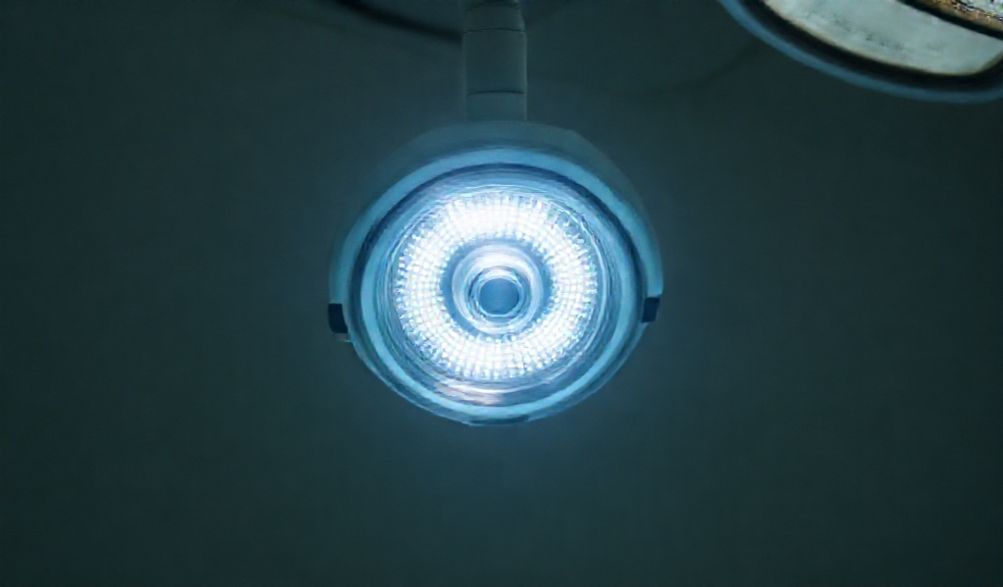
The magic of “shadow-free” light is achieved through physics and clever design. The primary method involves using a large-diameter light head (often 600mm to 900mm) containing hundreds of individual LED modules arranged in concentric rings. Each LED is focused on the same surgical site from a slightly different angle. When a hand or instrument blocks the light from one set of LEDs, the others fill in the shadow, creating remarkably even illumination. This “multi-point source” principle is the cornerstone of modern surgical lighting.
Color Temperature and Rendering Index (CRI): Seeing Tissues True-to-Life
- Color Temperature: Measured in Kelvins (K), this describes the visual “warmth” or “coolness” of light. The optimal range for surgery is between 4000K and 5000K—a neutral, daylight-like white that provides excellent contrast without causing blue-light fatigue.
- Индекс цветопередачи (CRI): As noted, a CRI of 90-95+ is non-negotiable for accurate tissue differentiation. Leading manufacturers often exceed standard CRI metrics with proprietary spectral technologies to enhance the visualization of specific tissue types and fluids.
Depth of Illumination: Penetrating Deep Cavities Effectively
A light that is bright on the surface but fails to illuminate a deep abdominal or pelvic cavity is useless. Depth of illumination refers to a light’s ability to deliver adequate, focused intensity at varying working distances (typically 1 to 1.5 meters from the light head to the surgical site). This is a function of optical lens design and total luminous flux, ensuring the surgeon has sufficient light even in the deepest recesses of a wound.
A Framework for Selecting the Right Surgical Light System
Выбор surgeon light is a strategic investment. A systematic evaluation framework ensures the selection aligns with clinical, operational, and financial goals.
Assessing Surgical Specialty Requirements
Different specialties have unique visual demands:
* General & Trauma Surgery: Require versatile lights with excellent depth and shadow control for large, open cavities.
* Neurosurgery & ENT: Demand extremely high intensity and precision for small, deep-seated anatomical fields.
* Cardiac & Orthopedic: Benefit from lights that manage reflections off shiny surfaces (bone, membranes) and provide wide coverage.
* Minimally Invasive Suites: Need lights with adjustable color temperature to balance ambient OR light with the glow from large monitor screens, reducing eye strain for surgeons who look between the field and the display.
Evaluating Mechanical Performance: Movement, Stability, and Sterility
The best optical system is undermined by poor mechanics. Critical factors include:
* Reach & Articulation: The light must cover the entire OR table from its mount without obstructing staff. Multi-jointed arms should allow effortless, fluid positioning with a single touch.
* Stability & Braking: Once positioned, the light head must remain perfectly still, resisting bumps and vibrations. Electromagnetic or mechanical braking systems should hold position securely.
* Sterile Design: The light head must be seamlessly sealed, allowing for aggressive disinfection with hospital-grade cleaners. Sterile handles or touchless control options are essential for intraoperative adjustments.
Total Cost of Ownership (TCO): Initial Investment vs. Long-Term Value
The purchase price is just one component. A true TCO analysis considers:
* Потребление энергии: LED systems offer dramatic savings on electricity.
* Обслуживание и время простоя: The long lifespan of LEDs eliminates bulb costs and reduces OR disruptions. Assess the reliability track record and service network of the manufacturer.
* Прочность: A robustly built light from quality materials will withstand years of daily use and cleaning, protecting your capital investment.
Установка, техническое обслуживание и передовые методы для оптимальной работы
Proper integration and care are essential to realize the full potential of a surgical lighting system.
Strategic Planning: Integration into the Operating Room Layout
Planning must occur early, often during OR design or renovation. Considerations include:
* Mounting: Ceiling-mounted single lights, double lights, or track systems offer different levels of flexibility and coverage. The choice depends on OR size, table positioning, and typical team size.
* Clearance: Ensure the light’s range of motion does not conflict with other ceiling-mounted equipment (booms, monitors, anesthesia screens) and allows free movement for staff.
Протоколы регулярной очистки и профилактического обслуживания
Adherence to manufacturer protocols is vital:
* Ежедневная очистка: Use only approved, non-abrasive disinfectants on sealed surfaces to maintain sterility without damaging coatings or optics.
* Scheduled Maintenance: Regular inspections by clinical engineering staff for arm tension, brake function, and electrical integrity prevent failures.
* Optics Check: Periodic verification of light intensity and color metrics ensures the system performs to its original specification.
Safety Checks and Compliance with Medical Device Regulations
Surgical lights must comply with stringent international standards, primarily IEC 60601-2-41, which governs safety and essential performance. Regular electrical safety testing and documentation are mandatory for hospital accreditation and, most importantly, for patient and staff safety.
The Future of Surgical Illumination: Emerging Trends
— это не просто улучшение освещения; это фундаментальное усовершенствование самого критически важного инструмента хирурга — его зрения. Благодаря непревзойденной цветопередаче, бестеневому освещению и эргономичному комфорту эта технология напрямую способствует хирургической точности, снижает утомляемость во время операции и способствует положительным результатам для пациента. Переход от галогенных к светодиодным осветителям — это не просто смена оборудования, а стратегические инвестиции в клинические результаты и профессиональное благополучие. surgeon light is evolving from an illumination device into an integrated visualization and data node within the smart OR.
Integration with Imaging and Advanced Visualization Systems
We are seeing lights with built-in 4K cameras for teaching and documentation, and specialized modes for fluorescence-guided surgery (e.g., Indocyanine Green imaging). In hybrid ORs, lights synchronize with imaging systems to optimize ambient conditions during angiograms or other procedures.
Smart Lights and Data Connectivity
The next generation features ambient light sensors for automatic brightness adjustment, touchless gesture or voice control, and connectivity to OR integration networks. This allows lighting presets to be part of a “procedure profile” that also sets room lights, monitor layouts, and table position.
Enhanced Ergonomics and Adaptive Lighting Scenarios
Future developments point toward even more intuitive control, adaptive lighting that changes color temperature or pattern based on the surgical phase (e.g., brighter, cooler light for incision; softer, warmer light for closure), and continued advances in reducing any residual thermal output.
Раздел Часто задаваемых вопросов (ЧАВО)
Q1: What is the most important factor when choosing a surgeon light?
A: There is no single factor; it’s a balance. However, optimal shadow reduction and excellent color rendering (high CRI) are fundamentally critical for visual clarity and accuracy, directly impacting patient safety.
В2: Какой срок службы обычно у современных светодиодных хирургических светильников?
A: High-quality LED surgical lights often have a rated lifespan of 40,000 to 60,000 hours, which translates to over a decade of typical OR use, significantly reducing maintenance costs compared to older technologies.
Q3: Can surgical lights be adjusted during a procedure without breaking sterility?
A: Yes. Modern systems are designed for sterile handling. Common features include sterile handles on the light head, touchless gesture or voice control, and controls that can be operated by circulating nurses outside the sterile field.
Q4: What’s the difference between a “surgical light” and an “examination light”?
A: Surgical lights are engineered for deep-cavity, shadow-free illumination with high intensity and specialized color quality for prolonged, critical tasks. Examination lights provide general surface illumination for diagnosis or minor procedures and lack the advanced optics and intensity for major surgery.
Q5: Are there specific lights for minimally invasive or endoscopic surgery?
A: While endoscopic cameras provide internal views, specialized ambient OR lighting is still crucial. Lights for these suites often have different color temperatures to balance screen and ambient light, reducing surgeon eye strain during hybrid procedures.
Заключение
The surgical light is far more than infrastructure; it is a pivotal, technology-driven extension of the surgeon’s own senses. Its role in enabling precision, safeguarding performance, and ensuring patient safety cannot be overstated. Investing in the right system is not merely a capital expenditure—it is a direct investment in enhanced clinical outcomes, team well-being, and operational efficiency.
As you evaluate options, prioritize a holistic assessment that weighs clinical need against technological merit and long-term value. Engage your surgical teams and clinical engineers in the process, and partner with manufacturers who demonstrate a deep understanding of the OR environment. The future of surgery is brighter and clearer than ever, driven by continuous innovation in the fundamental tool of vision: the surgeon light.
p>