
Hospital Lighting: A Guide to Healing Environments, Safety, and Compliance
Light is a fundamental force of life. It governs our biological clocks, influences our mood, and shapes our perception of the world. Now, consider this: what if the lighting in a hospital could directly influence patient recovery, staff well-being, and clinical outcomes? The answer, supported by a growing body of evidence, is that it does. Far from being a mere utility, hospital lighting is a critical, yet often underestimated, component of healthcare infrastructure. It is a powerful therapeutic tool, a vital safety system, and a key factor in operational efficiency.
This guide moves beyond basic illumination to explore the sophisticated, multifaceted role of light in healthcare settings. Synthesizing insights from healthcare design principles, clinical research, and stringent facility management standards, we provide a comprehensive resource for healthcare administrators, facility managers, architects, and design professionals. We will delve into how lighting impacts patient healing and staff performance, unpack the critical safety and regulatory standards that govern it, and examine the practical considerations for modern design and technology selection. Understanding hospital lighting is not just about choosing fixtures; it’s about engineering an environment that actively promotes health.
The Critical Role of Lighting in Healthcare Environments
In a hospital, every element of the built environment sends a message. Lighting, perhaps more than any other feature, communicates whether a space is for healing, for high-stakes intervention, or for rest. Its role extends far beyond simply allowing people to see.
Beyond Illumination: Lighting as a Therapeutic Tool
Modern healthcare lighting design is rooted in a holistic understanding of patient needs. It recognizes that the visual environment can either support or hinder the healing process.
- Impact on Recovery: Studies have shown that access to natural light and well-designed artificial lighting can lead to reduced patient recovery times and shorter lengths of stay. Patients in sunlit rooms have been reported to experience less stress and require fewer pain medications.
- Regulating Circadian Rhythms: Our sleep-wake cycles are governed by circadian rhythms, which are highly sensitive to light. In environments like Intensive Care Units (ICUs) or long-term care facilities, where patients may be disconnected from natural day-night cycles, inappropriate lighting can cause severe circadian disruption. This “circadian chaos” is linked to delirium, poor sleep, and slower recovery. Therapeutic lighting aims to reinforce a healthy rhythm, providing bright, blue-enriched light during the day and warm, dim light at night.
- Psychological Well-being: Harsh, flickering, or gloomy lighting can exacerbate anxiety and depression. Conversely, thoughtful lighting that mimics nature, reduces glare, and offers patient control can create a more calming, less institutional atmosphere, directly benefiting mental health.
Supporting Clinical Staff: Accuracy, Safety, and Well-being
The demands on healthcare professionals are immense, and lighting is a silent partner in their performance. Inadequate lighting is a contributor to eye strain, fatigue, and error.
- Reducing Fatigue: Nurses and doctors working long, irregular shifts are particularly vulnerable to the effects of poor lighting. Glare on computer screens, insufficient task lighting, and constant adaptation between bright and dark spaces cause visual fatigue, which compounds overall tiredness and can impact judgment.
- Enabling Visual Acuity: Clinical tasks demand precision. Whether it’s reading a patient’s chart, assessing a wound’s true color and condition, differentiating vein colors for cannulation, or performing a delicate surgical procedure, proper illumination is non-negotiable. The right light level, color quality, and direction are essential for accuracy.
- Promoting Safety and Morale: A well-lit environment is a safer environment. It helps staff navigate quickly, identify potential hazards, and perform protocols correctly, thereby reducing the risk of medical errors. Furthermore, a workspace with good lighting that supports circadian health can improve staff alertness, mood, and overall job satisfaction.
Creating a Healing Environment for Visitors and Families
Hospitals are stressful for loved ones, too. Lighting plays a key role in shaping their experience.
- Intuitive Wayfinding: Clear, consistent lighting can guide visitors intuitively. Highlighted pathways, illuminated signage, and distinct lighting in key areas (e.g., reception, waiting areas, cafeterias) reduce confusion and anxiety in an often-disorienting building.
- Welcoming Public Spaces: Waiting rooms and lobbies should feel welcoming, not sterile. Using warmer color temperatures, incorporating indirect lighting to soften shadows, and creating visual interest with light can make these spaces feel less stressful and more supportive for anxious families.
Key Standards and Safety Regulations for Hospital Lighting
Hospital lighting is governed by a complex web of codes and standards. Compliance is not optional; it is a fundamental requirement for patient safety, infection control, and operational licensure.
Navigating Essential Compliance: NFPA, IEC, and Joint Commission Guidelines
- NFPA 70: National Electrical Code (NEC): This is the baseline for all electrical installations in the United States. It includes specific articles on healthcare facilities (Article 517), mandating requirements for wiring methods, grounding, and the separation of emergency power systems. Understanding these codes is essential for any retrofit or new construction.
- IEC 60601 Series: For any lighting integrated with or near medical electrical equipment (like an MRI-compatible light or a surgical light), international standards like IEC 60601-1 apply. They ensure the device does not interfere with sensitive equipment and is safe for use in the patient vicinity.
- The Joint Commission (TJC) and Other Accreditors: Accreditation bodies survey facilities against standards that include the physical environment. Lighting factors into life safety (egress lighting), infection control (cleanable surfaces), and the overall care environment. Non-compliance can impact a hospital’s accreditation status.
Infection Control and Cleanability
In healthcare, every surface is a potential reservoir for pathogens. Lighting fixtures must be designed accordingly.
- Fixture Design: In high-risk areas like operating theaters, isolation rooms, and cleanrooms, fixtures must be completely sealed, with smooth, non-porous surfaces that can withstand frequent and aggressive cleaning with disinfectants. Designs should avoid dust-collecting ledges, seams, and grilles.
- IP Ratings: The Ingress Protection (IP) rating indicates a fixture’s resistance to solids and liquids. In areas subject to wash-down (e.g., sterile processing, certain bathrooms), fixtures with a high IP rating (e.g., IP65) are required to prevent water ingress and damage.
Emergency and Egress Lighting Requirements
When primary power fails, lighting becomes a critical life-safety system.
- Mandated Backup: Codes strictly mandate automatic emergency lighting in corridors, stairwells, exit paths, and other critical care areas. This system must activate within 10 seconds of a power outage.
- Exit Signs: Illuminated exit signs with battery backup are required at all exits and along the egress path.
- Generator Power: Essential areas like operating rooms, ICUs, and emergency departments are typically on emergency generator circuits to ensure life-support and critical procedure lighting remains operational.
Designing a Hospital Lighting Scheme: Areas of Application
A one-size-fits-all approach fails in a hospital. Each area has unique functional and human needs that must be addressed by the lighting design.
Patient Room Lighting: Balancing Comfort and Care
The patient room is a bedroom, a examination room, and a living space. Its lighting must be layered and flexible.
- General Ambient Lighting: Provides overall, shadow-free illumination. It should be dimmable to accommodate day and night.
- Examination Lighting: A high-output, color-accurate light, often mounted on a ceiling track or articulated arm, for clinical assessments by staff.
- Patient-Created Lighting: A personal, controllable reading light and often an over-bed light with separate controls allows the patient to adjust their immediate environment without disturbing a roommate.
- Circadian Support: The ideal modern solution is a tunable white system that can change its color temperature from a cool, alerting white (~4000K) during the day to a warm, relaxing white (~2700K) in the evening.
Surgical Suite and Procedure Room Lighting
Here, lighting is a precision instrument.
- Surgical Lights: These provide intense, shadow-reduced illumination directly into deep cavities. Key features include high Color Rendering Index (CRI), the ability to maintain color temperature as they dim, and sterilization-friendly surfaces.
- Ambient Room Lighting: Provides general illumination for setup, cleanup, and when the surgical light is not in use. It must integrate seamlessly with the surgical system and support a sterile field.
Diagnostic and Imaging Areas (MRI, Radiology)
Lighting must not interfere with sensitive technology.
- MRI Suites: All fixtures, wiring, and components within the MRI scanner room must be non-ferrous (non-magnetic) to prevent dangerous projectile hazards and shielded to avoid radio frequency interference (RFI) that can distort images.
- Radiology Reading Rooms: Lighting must be carefully controlled to eliminate glare on high-resolution diagnostic monitors. Dimmable, indirect lighting is standard to prevent eye strain during long image review sessions.
Corridors, Nurses’ Stations, and Common Areas
These connective and functional spaces have distinct needs.
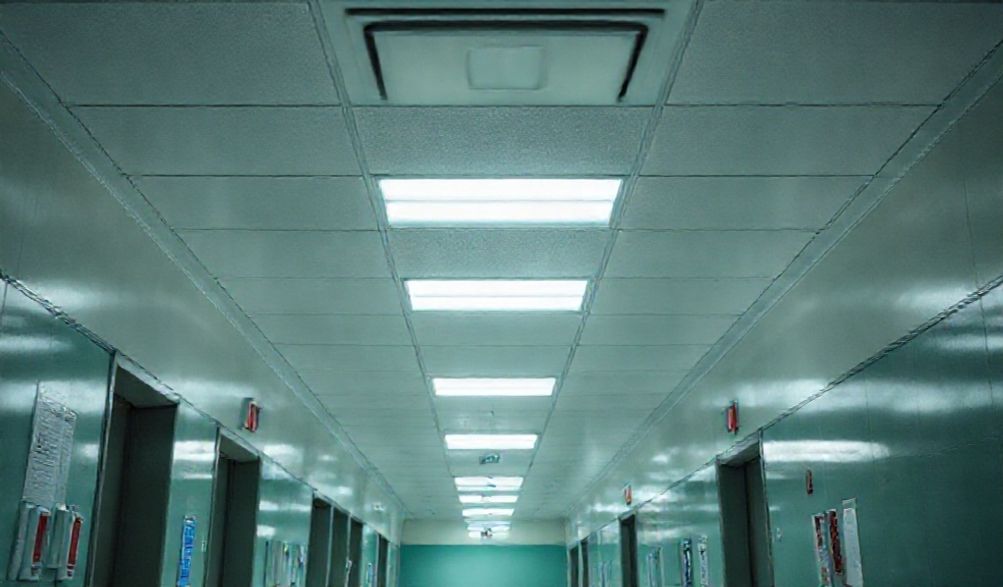
- Corridors: Require uniform, consistent illumination for safe patient transport, wayfinding, and fall prevention. Nighttime settings should provide lower, warmer light levels for quiet periods.
- Nurses’ Stations: Need a combination of ambient light and high-quality task lighting for computer work, paperwork, and communication, all while minimizing glare and screen reflections.
- Waiting Areas: Should employ warmer color temperatures and softer, often indirect, lighting to create a less clinical, more calming atmosphere for visitors.
Technology and Innovation in Modern Hospital Lighting
Advancements in lighting technology are revolutionizing what’s possible in healthcare environments, offering unprecedented control, efficiency, and therapeutic benefits.
The LED Revolution: Benefits for Healthcare
Light Emitting Diode (LED) technology is now the standard, and for good reason:
- Energy Efficiency & Longevity: LEDs consume significantly less power than fluorescent or halogen sources and have lifespans exceeding 50,000 hours, drastically reducing maintenance costs and bulb replacement in hard-to-reach areas.
- Performance Control: They are inherently dimmable and generate very little radiant heat, improving patient and staff comfort, especially in exam rooms.
- High CRI: LEDs can be engineered with a very high Color Rendering Index (CRI >90), which is crucial for accurate clinical observation of skin tones, tissue health, and bodily fluids.
Human-Centric Lighting (HCL) and Tunable White Systems
This is lighting designed around human biological needs.
- Concept: HCL systems dynamically adjust light intensity and color temperature throughout the day to mimic the natural progression of sunlight, actively supporting circadian rhythm regulation.
- Use Cases: Particularly transformative in areas like Neonatal ICUs (to help pre-term infants develop circadian rhythms), Dementia Care Units (to reduce sundowning agitation), and Psychiatric Facilities (to support mood and sleep patterns).
Smart Lighting Systems and IoT Integration
Lighting is becoming an intelligent part of the building’s nervous system.
- Sensors & Controls: Occupancy and vacancy sensors can automatically turn lights off in unoccupied rooms, saving energy. Light sensors can adjust artificial light based on available daylight (daylight harvesting).
- Building Integration: Smart lighting systems can be integrated with the Building Management System (BMS) for centralized control and data collection. There is also potential for integration with nurse call systems—for example, a patient’s room light could gently pulse when a nurse is being called to provide a visual cue.
UV-C Disinfection Lighting: Applications and Safety Protocols
Ultraviolet-C (UV-C) light is a proven technology for air and surface disinfection.
- Application : UV-C fixtures are used for terminal room disinfection after a patient is discharged, targeting high-touch surfaces and the air to supplement manual cleaning. They are also used in air handling units to treat circulating air.
- Critical Safety Warning: UV-C radiation is extremely hazardous to skin and eyes. Its use mandates strict safety protocols: it must only operate in unoccupied rooms with interlocked door and motion sensors that immediately shut it off if someone enters. Staff require specialized training. It is a powerful tool, but it is a supplement to—not a replacement for—standard cleaning procedures.
Foire Aux Questions (FAQ) sur l'Éclairage Hospitalier
Quelle est la température de couleur idéale (en Kelvin) pour une chambre de patient standard ?
Il n'existe pas de température de couleur statique unique “ idéale ”. La meilleure pratique consiste à utiliser un système à blanc réglable. Cela permet de programmer l'éclairage sur un blanc plus froid et stimulant (~4000K) pendant la journée pour soutenir l'activité et les rythmes circadiens, puis de le faire évoluer progressivement vers un blanc plus chaud et apaisant (~2700K-3000K) en soirée pour favoriser le repos et le sommeil.
Comment l'éclairage contribue-t-il à réduire les chutes des patients ?
Un éclairage approprié est une stratégie clé de prévention des chutes. Il garantit un éclairement uniforme et sans ombre sur tous les parcours, notamment du lit à la salle de bain. L'installation de veilleuses de faible intensité à tonalité chaude (par exemple, dans les plinthes ou sous les marches) fournit un guidage suffisant pour les déplacements nocturnes sans créer une lumière vive qui réveillerait complètement le patient ou perturberait son cycle de sommeil.
Existe-t-il des exigences spécifiques d'éclairage pour les unités de santé comportementale ?
Oui, les exigences sont strictes et axées sur la sécurité et le bien-être. Les luminaires doivent être résistants aux ligatures (pas de cordons exposés, antivandalisme et conçus pour empêcher qu'on y attache quoi que ce soit). Ils doivent être extrêmement durables. La qualité de la lumière est également cruciale : un éclairage chaud et indirect qui minimise l'éblouissement et le papillotement est utilisé pour créer une atmosphère apaisante. Tous les composants sont généralement sécurisés derrière des lentilles incassables.
Quels sont les facteurs les plus importants lors de la modernisation de l'éclairage d'un hôpital ancien avec des LED ?
1. Compatibilité électrique : S'assurer que le câblage et les systèmes de contrôle existants sont compatibles avec les alimentations LED. La modernisation peut nécessiter un recâblage ou de nouvelles interfaces de contrôle.
2. Performance sans papillotement : Spécifier des LED de qualité médicale, sans papillotement, pour prévenir les maux de tête et la fatigue oculaire.
3. High CRI: Choisir des LED avec un IRC de 90+ pour une observation clinique précise.
4. Conformité aux normes : La modernisation doit amener le système d'éclairage à se conformer aux normes actuelles de la NEC et aux codes de sécurité incendie.
5. Élimination sécurisée : Prévoir l'élimination correcte et écologique des anciens tubes fluorescents, qui contiennent du mercure.
Qui doit être impliqué dans la planification d'une nouvelle conception d'éclairage pour un hôpital ?
Une conception réussie nécessite une équipe multidisciplinaire: architectes et designers d'intérieur spécialisés en santé, ingénieurs en électricité, responsables des installations et directeurs de l'ingénierie, préventionnistes en contrôle des infections, et—de manière cruciale—des représentants du personnel clinique (infirmiers de différentes unités, chirurgiens et thérapeutes). Leur expérience de terrain est inestimable pour créer une conception fonctionnelle et centrée sur l'humain.
Conclusion
L'éclairage hospitalier a évolué d'une simple commodité à un composant sophistiqué et intégral des soins aux patients et du fonctionnement de l'établissement. C'est un outil thérapeutique qui peut raccourcir les temps de récupération, un système de sécurité qui prévient les erreurs et les chutes, et un atout opérationnel qui améliore le bien-être du personnel et réduit les coûts énergétiques. Investir dans une conception d'éclairage réfléchie et fondée sur des preuves, c'est investir dans la mission fondamentale des soins de santé : la guérison.
À l'avenir, nous pouvons nous attendre à une intégration encore plus poussée, avec des systèmes d'éclairage intégrant des capteurs biométriques et utilisant l'intelligence artificielle pour créer des environnements véritablement adaptatifs qui répondent en temps réel aux besoins des occupants.
En fin de compte, la mise en œuvre d'un éclairage hospitalier efficace nécessite une expertise. Il est fortement conseillé de s'associer à des concepteurs et consultants en éclairage spécialisés dans le secteur de la santé et possédant une compréhension approfondie des dernières recherches, des technologies innovantes et de l'évolution constante des codes et normes. L'objectif doit toujours être de créer un environnement sûr, efficace et profondément axé sur la guérison, où la lumière elle-même devient un membre de l'équipe soignante.
Appel à l'action : Examinez l'éclairage de votre établissement. Soutient-il activement la guérison et la sécurité, ou est-il simplement fonctionnel ? Commencez par réaliser un audit d'éclairage ou faites de l'éclairage centré sur l'humain une priorité dans votre prochain projet de rénovation ou de construction. Entamez la conversation avec les personnes qui comptent le plus—vos patients et votre personnel—et élaborez votre plan à partir de là.
p>