
Surgery Lights: A Comprehensive Guide to Types, Features, and Selection for Optimal Outcomes
Introduction
Imagine a surgeon performing a delicate microvascular anastomosis, reconnecting blood vessels less than a millimeter in diameter. The success of this procedure, and indeed nearly every surgical intervention, hinges on a factor so fundamental it’s often taken for granted: light. From the era of sunlight and candlelit operating theaters to the focused beams of early electric lamps, the evolution of surgical illumination mirrors the advancement of surgery itself. Today, modern surgery lights are sophisticated medical devices, engineered to a standard that directly impacts patient outcomes, surgical precision, and team well-being.
This guide is compiled from insights into the rigorous demands of surgical environments and the meticulous processes behind medical equipment specification. Our analysis is grounded in adherence to international medical device standards, such as l'IEC 60601-2-41 for safety and DIN 5035 for photometric requirements, and is aligned with principles from clinical engineering. We reference the authoritative guidelines of institutions like the Association of periOperative Registered Nurses (AORN) and the World Health Organization’s (WHO) surgical safety protocols, which explicitly emphasize the critical role of optimal illumination. Our commitment is to provide an objective, feature-based comparison to empower informed decision-making, focusing on key considerations rather than brand promotion.
This comprehensive guide will illuminate the advanced technology behind modern surgery lights, detail their profound impact on surgical precision and team ergonomics, and provide a structured, practical framework for their evaluation and selection.
The Critical Role of Illumination in Modern Surgery
A surgery light does far more than simply “light up” the operative field. It is a precision tool designed to meet the exacting visual demands of the surgical team, transforming their ability to see, interpret, and act.
Beyond Basic Visibility: Enhancing Precision and Safety
The primary goal is to create an optimal visual environment that minimizes cognitive load and maximizes accuracy.
* Depth Perception: High-quality surgical lighting provides homogeneous illumination that eliminates flatness, allowing surgeons to accurately perceive the three-dimensional anatomy of the surgical cavity. This is crucial for judging distances during dissection, suturing, and implant placement.
* Color Rendition: Accurate tissue differentiation is vital. Surgeons must reliably distinguish between arterial blood (bright red), venous blood (darker red), fatty tissue (yellow), nerves (white/pearly), and various organ tissues. Poor color rendering can lead to misinterpretation.
* Reduction of Visual Fatigue: Long procedures under inconsistent or glaring light cause pupil constriction and dilation cycles, leading to eye strain, headaches, and decreased concentration. A stable, shadow-reduced light field minimizes this fatigue, helping to maintain peak performance throughout an operation.
Impact on Surgical Team Performance and Well-being
The ergonomics of the surgery light directly affect the physical well-being of the entire team.
* Ergonomics and Strain Reduction: A light that is difficult to position or that creates harsh shadows forces surgeons and assistants into awkward, static postures as they crane to see into the wound. Over time, this contributes to neck, shoulder, and back strain. Intuitive, effortless maneuverability is therefore an ergonomic necessity.
* Mitigation of Shadow Interference: Traditional single-point lights cast the surgeon’s head and hands as deep, obstructive shadows. Modern systems are designed specifically to penetrate and fill these shadows, ensuring a clear view regardless of the angle or number of hands in the field. This reduces the physical and mental strain of constantly repositioning to find light.
Core Technologies and Types of Surgical Lights
Understanding the core technology and physical form of a surgery light is the first step in selection.
LED vs Halogène : Une comparaison technologique
The shift from halogen to LED represents the most significant technological leap in surgical lighting in decades.
-
LED (Light Emitting Diode): The current industry standard.
- Efficiency & Heat: Extremely energy-efficient, converting most energy into light with minimal waste heat. This dramatically reduces thermal radiation onto the surgical site, lowering the risk of tissue desiccation and improving patient comfort.
- Durée de vie : Offers an exceptionally long service life, typically 30,000 to 50,000 hours. This translates to over a decade of regular use without a bulb change.
- Coût Total de Possession (CTP) : While the initial purchase price may be higher, the savings in energy consumption, negligible maintenance, and elimination of frequent bulb replacements result in a significantly lower TCO over 5-10 years.
- Performance : Provides instant, full-intensity light with excellent color stability over the diode’s entire lifespan.
-
Halogène : Largely considered legacy technology.
- Heat Emission: Operates at very high temperatures, with over 90% of energy emitted as infrared (heat) radiation, which can be detrimental to exposed tissues.
- Durée de vie : Much shorter, typically 1,000 to 2,000 hours, necessitating frequent, costly bulb changes and associated sterilization downtime.
- TCO: Lower initial cost is offset by high ongoing costs for bulbs, energy, and cooling requirements to manage OR heat load.
Verdict: For new purchases or upgrades, LED technology is the unequivocal choice for its clinical, operational, and economic benefits.
Common Surgical Light Configurations
- Single Dome Lights: A single light head, often ceiling-mounted on a multi-jointed arm. Ideal for standard operating rooms dedicated to a wide range of general surgery, orthopedic, or gynecological procedures. They offer excellent flexibility and are a cost-effective solution for many settings.
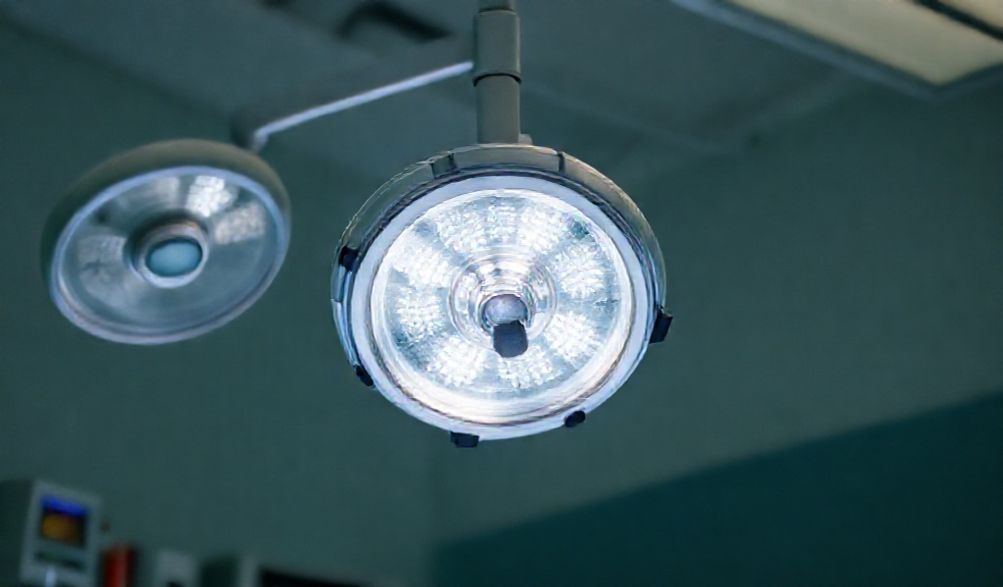
- Multi-Dome/Ceiling Mounted Systems: Feature two or more light heads mounted on a single central column or independent arms. This is the gold standard for major complex procedures (e.g., cardiac, neuro, transplant). The multiple heads provide overlapping fields of light for superior shadow reduction and depth of field, and offer redundancy—if one light fails, the other can provide adequate illumination.
- Wall-Mounted and Mobile Lights: Wall-mounted lights save ceiling space and are useful in minor procedure rooms or where ceiling infrastructure is limited. Mobile (floor-standing) surgery lights offer ultimate flexibility for emergency rooms, trauma bays, labor & delivery rooms, or as supplemental lighting in main ORs.
Key Performance Features to Evaluate
When comparing models, these technical specifications and design features separate adequate lighting from exceptional lighting.
Illumination Quality Metrics
- Lux (lx): The measure of illuminance, or light intensity, on the surgical field. While extremely high lux values (e.g., 160,000+ lx) are marketed, what matters more is homogeneous intensity across the entire field. A consistent 40,000 – 100,000 lx is often sufficient for most procedures if it is evenly distributed.
- Température de Couleur : Measured in Kelvin (K), this describes the “warmth” or “coolness” of the white light. Surgical lights typically range from 3500K (warm, yellowish) to 5000K (cool, bluish). 4000K – 4500K is widely considered the ideal “daylight white,” providing a neutral tone that reduces eye strain and offers good contrast.
- Indice de Rendu des Couleurs (IRC) : Arguably the most critical metric. CRI measures a light source’s ability to reveal the true colors of objects compared to natural light. For surgery, a CRI of ≥90 is essential, and ≥95 is ideal. A high CRI is non-negotiable for accurately distinguishing subtle tissue variations, such as identifying ischemic bowel or differentiating between tumor margins and healthy tissue.
Design and Functionality Features
- Réduction des ombres : Achieved through two primary methods: 1) Multiple point sources (from a multi-dome design or a single dome with several LED clusters) whose beams intersect to fill in shadows, and 2) Advanced diffusion optics that scatter light to create a soft, homogeneous field. Look for terms like “deep cavity illumination” or “patented shadow management.”
- Depth of Field: The ability to maintain focused light intensity even at the base of a deep wound (e.g., in spinal or pelvic surgery). A good surgery light will have a deep depth of field, meaning the light diameter and intensity change minimally as the head is raised or lowered.
- Maneuverability & Sterility: The light must be effortlessly positioned. Features to seek include:
- Perfect Balance Systems: Allow the heavy light head to be moved with a fingertip touch and stay securely in position.
- Poignées Stériles : Designed for single-use sterile sleeves, allowing the circulating nurse or surgeon to adjust the light without breaking the sterile field.
- Portée et articulation : Ensure the light’s arms provide sufficient coverage over the entire OR table from its mounting point.
A Step-by-Step Guide to Selecting the Right Surgery Light
Le choix d'une surgery light is a strategic process that aligns technology with clinical and operational reality.
Assessing Your Clinical Requirements
Begin by answering these key questions:
* Procedure Mix: What types of surgeries are most frequently performed? (e.g., deep-cavity laparoscopy, surface-level plastics, microsurgery).
* OR Team Feedback: What are the common complaints about current lighting from surgeons and nurses?
* Physical Environment: What are the room dimensions, ceiling height, and table location? Is there existing infrastructure (tracks, columns)?
* Future-Proofing: Are new surgical specialties (e.g., robotics) planned? Does the light need to integrate with other systems?
Budgeting and Total Cost of Ownership (TCO)
Move beyond the sticker price. A comprehensive budget should include:
1. Prix d'achat : Of the light(s) and mounting system.
2. Installation : Costs for certified installers, potential structural reinforcements, and electrical work.
3. Operational Costs: Projected energy consumption (LEDs use ~70% less power than halogen).
4. Maintenance Costs: Annual service contracts and the cost/labor of bulb replacements (virtually $0 for LED over 10 years vs. significant recurring cost for halogen).
5. Downtime Costs: The revenue lost when an OR is closed for bulb changes or repairs.
Compliance and Safety Standards Checklist
Ensure any considered model meets these non-negotiable requirements:
* Regulatory Certification: FDA 510(k) clearance (USA), CE Marking (Europe), or other regional medical device approvals.
* Safety Standards: La conformité à la norme l'IEC 60601-2-41 (particular requirements for surgical lights).
* Management de la Qualité : Manufactured under a certified l'ISO 13485. quality system.
* Critical Safety Feature: A backup battery system that automatically deploys in a power failure, providing at least 60 minutes of illumination for safe procedure termination.
Installation, Maintenance et Bonnes Pratiques
Considérations pour une Installation Professionnelle
Ceiling-mounted systems are heavy and complex. Installation doit be performed by the manufacturer’s certified technicians or authorized medical equipment planners. They will ensure:
* Intégrité Structurelle : The ceiling can support the dynamic and static loads.
* Sécurité électrique : Proper grounding and circuit protection.
* Optimal Positioning: Le luminaire est positionné pour une couverture maximale et une efficacité optimale du flux de travail.
Protocole de Maintenance de Routine
- Quotidien : Nettoyage des surfaces externes et des poignées stériles avec des désinfectants hospitaliers non abrasifs pour maintenir le contrôle des infections. Ne jamais pulvériser de produit nettoyant directement sur la tête lumineuse.
- Maintenance programmée : Suivre le calendrier du fabricant, généralement un entretien professionnel annuel. Celui-ci comprend la vérification de l'équilibre mécanique, l'étalonnage de l'intensité lumineuse et des capteurs de couleur, le nettoyage des optiques internes et la vérification du fonctionnement de la batterie de secours.
Dépannage des Problèmes Courants
- Scintillement/assombrissement : Souvent le signe d'une alimentation ou d'un pilote défaillant (pour les LED) ou de la fin de vie de l'ampoule (pour les halogènes). Vérifier d'abord les connexions, puis contacter le support technique.
- Mouvement raide ou dérive : Indique que le mécanisme d'équilibrage nécessite un réétalonnage ou que les roulements du bras nécessitent une lubrification. Ne pas forcer ; programmer une intervention.
- Dérive de couleur ou d'intensité : Les LED sont stables, mais les capteurs peuvent tomber en panne. Un réétalonnage par un technicien est nécessaire.
- Règle générale : Pour toute panne électronique ou mécanique, documenter le problème et contacter le support du fabricant. Ne pas tenter de réparations internes.
Section FAQ
Q : Quelle est la durée de vie typique d'une lumière chirurgicale LED par rapport à une lumière halogène ?
R : Un luminaire chirurgical LED a généralement une durée de vie de 30,000 to 50,000 hours. En revanche, une ampoule halogène dure 1,000 to 2,000 hours. Cela signifie qu'une lumière LED peut fonctionner pendant plus d'une décennie sans nécessiter de changement d“”ampoule", tandis qu'une lumière halogène nécessite un remplacement plusieurs fois par an en cas d'utilisation intensive.
Q2 : Quelle est l'importance de l'Indice de Rendu des Couleurs (IRC), et quelle valeur dois-je rechercher ?
R : L'IRC est d'une importance cruciale pour un diagnostic visuel précis pendant la chirurgie. Un IRC élevé garantit que les tissus, le sang et les organes apparaissent dans leurs vraies couleurs. Vous devriez rechercher un IRC minimum de 90, avec 95 ou plus comme objectif idéal pour discerner les variations les plus subtiles de la viabilité et de la morphologie des tissus.
Q3 : Les lumières de chirurgie peuvent-elles être intégrées à d'autres systèmes de salle d'opération ?
R : Oui, de nombreux modèles modernes surgery lights offrent des capacités d'intégration. Ils peuvent se connecter aux systèmes vidéo chirurgicaux pour fournir un éclairage optimal aux caméras, interfacer avec les panneaux de contrôle du bloc opératoire pour un réglage centralisé, et prendre en charge des protocoles de connectivité comme ORi™ (Intégration de Salle d'Opération). Il est essentiel de vérifier la compatibilité d'intégration spécifique avec votre infrastructure de bloc opératoire existante lors du processus de sélection.
Q4 : Quels sont les facteurs les plus critiques pour minimiser la fatigue oculaire du chirurgien pendant les interventions longues ?
R : Les facteurs clés sont : 1) Un champ lumineux homogène sans points chauds ni zones sombres, 2) Une excellente réduction supérieure des ombres stabilité de l'intensité pour éviter un ajustement constant de la pupille, 3) Un éblouissement minimal provenant des instruments ou surfaces réfléchissants, et 4) Une température de couleur neutre et appropriée (4000-4500K).
Q4 : À quelle fréquence une lumière chirurgicale doit-elle être entretenue professionnellement ?
R : qui imite la lumière du jour. une fois par an. Respectez le calendrier recommandé par le fabricant, qui est généralement.
Conclusion
Choisir une surgery light annuel. Ce service doit inclure des vérifications mécaniques, électriques et optiques. Cependant, si vous remarquez des problèmes de performance—comme un assombrissement, un décalage de couleur ou un mouvement raide—contactez immédiatement le support technique pour un contrôle préventif.
Ce guide a été structuré pour offrir une base fiable à cette décision, ancrée dans des normes internationales établies et les réalités opérationnelles pratiques. Nous soulignons l'importance d'aller au-delà des brochures et de procéder à une évaluation pratique. Consultez toujours votre équipe d'ingénierie clinique et exigez une démonstration en direct dans un environnement de bloc opératoire simulé avant de finaliser tout achat.
Votre prochaine étape : Téléchargez une liste de contrôle de spécifications détaillées pour comparer systématiquement les modèles, ou contactez un planificateur d'équipements médicaux certifié pour réaliser une évaluation professionnelle de votre agencement de bloc opératoire et de vos exigences de flux de travail spécifiques.
p>