
Hospital Lighting: A Guide to Healing Environments, Safety, and Compliance
Introduction
What if the very light in a hospital room could accelerate healing, sharpen a surgeon’s focus, and soothe a worried family? This isn’t a futuristic concept; it’s a present-day reality grounded in science. Light is a fundamental biological and psychological regulator, and in the high-stakes environment of a healthcare facility, its impact is profound. Hospital lighting is a critical, yet often underappreciated, component of healthcare infrastructure. It transcends the basic function of illumination to become a tool for healing, a safeguard for safety, a driver of operational efficiency, and a domain governed by strict regulatory standards.
This guide synthesizes insights from evidence-based healthcare design principles, peer-reviewed clinical studies, and established engineering standards to provide a comprehensive and trustworthy resource. We will explore the multifaceted role of hospital lighting, from its ability to support circadian rhythms and reduce patient stress to its necessity for ensuring surgical precision and meeting stringent energy codes. By the end, you will have a clear framework for understanding why lighting is not merely an architectural detail, but a vital element in the mission of care.
The Critical Role of Lighting in Healthcare Environments
Beyond Illumination: Lighting as a Healing Tool
For decades, hospital lighting was designed with a singular focus: to allow medical staff to see. Today, we understand it must also help patients heal. Research demonstrates that thoughtfully designed lighting can directly influence patient outcomes by reducing anxiety, alleviating symptoms of depression, and even decreasing the perception of pain. A well-lit room with a connection to natural daylight can create a more positive and less stressful environment, which is conducive to recovery.
Perhaps the most significant advancement is the understanding of circadian lighting. Our bodies operate on a 24-hour internal clock regulated by light cues, primarily blue-wavelength light. In a hospital, where patients are often confined and disconnected from natural day-night cycles, circadian rhythms can become dysregulated. This disruption impairs sleep, weakens the immune system, and can prolong recovery. Circadian lighting systems mimic the natural progression of daylight—cooler, brighter light during the day and warmer, dimmer light in the evening—to help stabilize these rhythms, especially for long-term or ICU patients. Frameworks like the WELL Building Standard now formally recognize and prescribe lighting strategies that support human health, cementing its role as a non-pharmacological intervention.
Supporting Clinical Staff Performance and Well-being
The well-being and performance of healthcare staff are paramount to patient safety. Lighting plays a dual role here: enabling precision and protecting health.
Task lighting is essential for accuracy in detailed work. Whether it’s a nurse preparing medications, a physician reviewing a chart, or a technician drawing blood, proper task illumination minimizes errors and reduces eye strain. In nursing stations, layered lighting that combines ambient light with focused task lights is key to maintaining a functional workspace over long shifts.
Furthermore, staff are not immune to circadian disruption. Nurses, doctors, and support personnel working night shifts or long hours are exposed to artificial light at biologically inappropriate times. Strategic lighting that supports their circadian health can reduce fatigue, improve alertness, and lower the risk of medical errors. Beyond biology, the quality of light in staff areas impacts morale. A space that feels bright, clear, and comfortable can combat the mental fatigue associated with high-stress work.
Key Areas and Their Specific Lighting Requirements
Patient Rooms: Comfort and Control
The patient room is a bedroom, a living room, and a clinical examination space all in one. Its lighting must be equally versatile, achieved through layers of light:
- Ambient/General Lighting: Provides overall, shadow-free illumination. It should be soft, diffuse, and free of glare on screens or resting patients.
- Task Lighting: Focused light for reading or writing, often integrated into an overbed table or a wall-mounted patient light.
- Examination Lighting: A high-output, high-CRI light source, typically a ceiling-mounted or wall-arm fixture, used by clinicians for assessments and procedures.
- Night Lighting: Low-level, warm-toned lighting for safe navigation without disrupting sleep. It should be strategically placed to illuminate the path to the bathroom.
Crucially, patient controllability is a pillar of patient-centered care. The ability to adjust ambient light levels and operate personal task lighting empowers patients, giving them a sense of autonomy and normalcy in an otherwise controlled environment.
Surgical Suites & Procedure Rooms: Precision and Safety
Here, lighting is a life-critical tool. Surgical luminaires are engineered to provide intense, shadow-free illumination deep into body cavities. Key features include:
* Shadow Reduction: Achieved through multiple light sources or large-diameter reflectors.
* High Color Rendering Index (CRI): Essential for accurate differentiation between tissues, arteries, veins, and organs.
* Heat Management: Advanced heat sinks and filters prevent thermal injury to tissue and improve surgeon comfort.
* Sterility and Integration: Fixtures must be seamlessly sealed for infection control and often integrate with other systems like imaging equipment and HVAC.
Hallways, Nurses’ Stations, and Common Areas
These circulation and work zones have distinct needs:
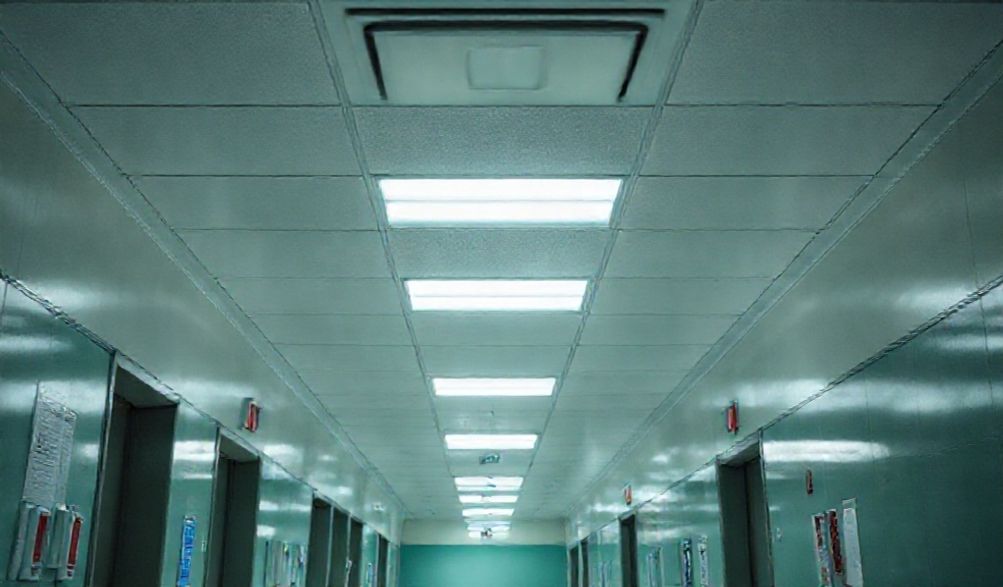
* Safety and Wayfinding: Hallways require consistent, uniform, and glare-free illumination to ensure safe mobility for patients, staff, and equipment. Lighting should clearly define paths and intersections.
* Atmosphere: Nurses’ stations and common areas (waiting rooms, lobbies) benefit from lighting that creates a welcoming, non-institutional feel. Warmer color temperatures, decorative elements, and connections to daylight can reduce anxiety for visitors and staff.
* Operational Efficiency: As 24/7 spaces, energy efficiency through LED technology and smart controls is a major consideration, without compromising on light quality or safety levels.
Essential Technical Considerations for Hospital Lighting
Understanding Light Metrics: CCT, CRI, and Lux Levels
Choosing the right light requires speaking the language of photometrics:
* Correlated Color Temperature (CCT): Measured in Kelvins (K), this describes whether light appears “warm” (2700K-3000K, yellowish) or “cool” (4000K-5000K, bluish). Warmer tones are used for ambient and patient comfort lighting, while cooler tones are preferred for tasks requiring alertness and visual acuity.
* Color Rendering Index (CRI): On a scale of 0-100, CRI measures a light source’s ability to reveal the true colors of objects compared to natural light. In clinical settings, a CRI of 90+ is essential for accurate diagnosis, wound assessment, and detecting subtle changes in patient coloration.
* Illuminance (Lux Levels): This is the amount of light falling on a surface. Guidelines from organizations like the Illuminating Engineering Society (IESNA) recommend specific lux levels for different tasks: e.g., 300 lux for a patient room general lighting, 1,000+ lux for an examination, and 10,000+ to 100,000+ lux at the surgical site.
Fixture Selection: Durability, Hygiene, and Maintenance
The hardware must withstand a demanding environment:
* Infection Control: Fixtures must be completely sealed, with smooth, cleanable surfaces that harbor no dust or pathogens. Recessed or flush-mounted options are often preferred.
* Durability: Built for 24/7 operation, fixtures should have robust construction and high-quality components to ensure longevity and reliability.
* Maintainability: Design should allow for easy lamp replacement, cleaning, and repair with minimal disruption to patient care areas. Modular designs are advantageous.
Compliance, Safety, and Sustainability
Navigating Codes and Standards
Hospital lighting is heavily regulated to ensure safety:
* Life Safety: NFPA 101, the Life Safety Code, mandates requirements for emergency egress lighting, exit signs, and battery backup duration to ensure safe evacuation during a power failure.
* Design Guidelines: The Facility Guidelines Institute (FGI) Guidelines provide detailed recommendations for lighting in various healthcare spaces, influencing many state codes.
* Energy Codes: The International Energy Conservation Code (IECC) and similar standards set limits on lighting power density, driving the adoption of efficient technologies.
The Shift to LED: Benefits and Best Practices
LED technology has revolutionized hospital lighting, but quality is non-negotiable:
* Benefits: Dramatic energy savings (often 50-70% over fluorescent), extremely long lifespans reducing maintenance, and instant-on capability.
* Critical Best Practices:
* Flicker-Free: Must use high-quality drivers to eliminate flicker, which can cause headaches, eye strain, and can be problematic for individuals with photosensitive conditions.
* Spectral Quality: Not all white LEDs are equal. Medical-grade LEDs should have excellent color consistency and spectral content that supports clinical tasks and well-being.
* Appropriate Dimming: Must be compatible with medical-grade dimming systems without causing flicker or audible noise.
Integrating Controls for Smart Lighting Systems
Intelligent controls unlock the full potential of modern lighting:
* Energy Automation: Occupancy/vacancy sensors, daylight harvesting, and scheduled dimming can lead to significant additional energy savings.
* Circadian Tuning: Tunable white LED systems can be programmed to automatically adjust CCT and intensity throughout the day to support patient and staff circadian health.
* Centralized Management: Facility-wide control systems allow for monitoring, scene setting, and troubleshooting from a single interface, improving operational efficiency.
FAQ Section
Q1: What is the most important factor when choosing lighting for a patient room?
A: The priority must be a balance between patient comfort and clinical functionality. This is achieved by providing layers of light that the patient can control (ambient, reading) while ensuring there is a separate, high-quality, high-CRI light source available for medical examinations. Patient autonomy over their immediate environment is crucial for psychological well-being.
Q2: Why is high CRI (Color Rendering Index) so critical in hospitals?
A: A high CRI (90+) is a patient safety issue. It allows clinicians to see true, natural colors. This is vital for accurately diagnosing conditions (like detecting cyanosis or jaundice), assessing wound healing and tissue viability, and noticing subtle changes in a patient’s condition. Poor color rendering can lead to visual fatigue and increase the risk of clinical error.
Q3: Are LED lights safe for all hospital areas?
A: Yes, but with a critical caveat: they must be high-quality, medically-specified LEDs. It is essential to select fixtures that are certified flicker-free, have a high CRI and consistent color temperature, and use appropriate dimming technology. Low-cost, flickering LEDs can cause significant discomfort, headaches, and eye strain for both patients and staff.
Q4: How does lighting contribute to hospital sustainability goals?
A: Modern LED-based lighting systems are a cornerstone of sustainable hospital operations. They consume a fraction of the energy of older technologies. When paired with smart controls (like occupancy sensors and daylight harvesting), energy savings are maximized. Their long lifespan also dramatically reduces waste from bulb replacements and lowers the carbon footprint associated with maintenance activities.
Q5: Who should be involved in planning a hospital lighting project?
A: A successful project requires a multidisciplinary team. This should include facility managers and engineers, clinical staff (nurses, surgeons, hospitalists), infection control practitioners, architects and specialized lighting designers, and biomedical engineering/IT staff. This collaborative approach ensures the final design meets clinical needs, operational realities, infection control protocols, and human factors.
Conclusion
Hospital lighting is far more than a utility; it is a vital therapeutic and operational tool that directly influences patient recovery rates, staff performance and safety, and institutional efficiency. From the calming glow in a patient room to the brilliant, shadow-free beam in an OR, light is an active participant in the healthcare journey.
Investing in well-designed, human-centric lighting is not merely an infrastructure expense. It is a strategic investment in the core mission of healthcare: to heal. It requires a thoughtful approach that carefully balances clinical requirements, human psychological and biological needs, and the possibilities of modern technology.
Ultimately, achieving an optimal healing environment through light demands a strategy guided by evidence-based design and the expertise of professionals who understand the unique confluence of medicine, architecture, and human physiology. We encourage administrators, clinicians, and designers to evaluate their current environments through this holistic lens and to engage with specialized healthcare lighting designers to turn illumination into a powerful agent of care and comfort.
p>